The Internet - The first Worldwide Tool of Unification ("The End of History")

" ... Now I give you something that few think about: What do you think the Internet is all about, historically? Citizens of all the countries on Earth can talk to one another without electronic borders. The young people of those nations can all see each other, talk to each other, and express opinions. No matter what the country does to suppress it, they're doing it anyway. They are putting together a network of consciousness, of oneness, a multicultural consciousness. It's here to stay. It's part of the new energy. The young people know it and are leading the way.... "

" ... I gave you a prophecy more than 10 years ago. I told you there would come a day when everyone could talk to everyone and, therefore, there could be no conspiracy. For conspiracy depends on separation and secrecy - something hiding in the dark that only a few know about. Seen the news lately? What is happening? Could it be that there is a new paradigm happening that seems to go against history?... " Read More …. "The End of History"- Nov 20, 2010 (Kryon channelled by Lee Carroll)

"Recalibration of Free Choice"– Mar 3, 2012 (Kryon Channelling by Lee Carroll) - (Subjects: (Old) Souls, Midpoint on 21-12-2012, Shift of Human Consciousness, Black & White vs. Color, 1 - Spirituality (Religions) shifting, Loose a Pope “soon”, 2 - Humans will change react to drama, 3 - Civilizations/Population on Earth, 4 - Alternate energy sources (Geothermal, Tidal (Paddle wheels), Wind), 5 – Financials Institutes/concepts will change (Integrity – Ethical) , 6 - News/Media/TV to change, 7 – Big Pharmaceutical company will collapse “soon”, (Keep people sick), (Integrity – Ethical) 8 – Wars will be over on Earth, Global Unity, … etc.) - (Text version)

“…5 - Integrity That May Surprise…

Have you seen innovation and invention in the past decade that required thinking out of the box of an old reality? Indeed, you have. I can't tell you what's coming, because you haven't thought of it yet! But the potentials of it are looming large. Let me give you an example, Let us say that 20 years ago, you predicted that there would be something called the Internet on a device you don't really have yet using technology that you can't imagine. You will have full libraries, buildings filled with books, in your hand - a worldwide encyclopedia of everything knowable, with the ability to look it up instantly! Not only that, but that look-up service isn't going to cost a penny! You can call friends and see them on a video screen, and it won't cost a penny! No matter how long you use this service and to what depth you use it, the service itself will be free.

Now, anyone listening to you back then would perhaps have said, "Even if we can believe the technological part, which we think is impossible, everything costs something. There has to be a charge for it! Otherwise, how would they stay in business?" The answer is this: With new invention comes new paradigms of business. You don't know what you don't know, so don't decide in advance what you think is coming based on an old energy world. ..."
(Subjects: Who/What is Kryon ?, Egypt Uprising, Iran/Persia Uprising, Peace in Middle East without Israel actively involved, Muhammad, "Conceptual" Youth Revolution, "Conceptual" Managed Business, Internet, Social Media, News Media, Google, Bankers, Global Unity,..... etc.)


German anti-hate speech group counters Facebook trolls

German anti-hate speech group counters Facebook trolls
Logo No Hate Speech Movement

Bundestag passes law to fine social media companies for not deleting hate speech

Honouring computing’s 1843 visionary, Lady Ada Lovelace. (Design of doodle by Kevin Laughlin)
Showing posts with label Google Apps. Show all posts

Thursday, November 19, 2015

Uber drops Uberpop taxi service in the Netherlands

DutchNews, November 18, 2015

Taxi app firm Uber is stopping its controversial Uberpop service in the Netherlands, the company said on Wednesday. 

Uberpop allows unlicenced drivers to use their own cars as taxis, but has been branded as illegal by the Dutch courts. 

The company is withdrawing the service because Uberpop is a ‘hindrance to the constructive dialogue about modernising the existing taxi rules’, Uber Nederland director Niek van Leeuwen said in a blog post. 

The services Uberblack, Uberlux and UberX, which involve licenced drivers, are not affected. 

Uber said earlier this year it would support Uberpop drivers in getting taxi licences, but Van Leeuwen said in his post that ‘we expect many of them will not be able to do this because of the high cost of complying with all the legal obligations’. 

Earlier this year, transport ministry inspectors raised the fine payable by Uber for breaking taxi sector rules to a maximum of €1m. Uberpop drivers themselves can be fined up to €4,200 and are given a criminal record.

Related Articles:

Wednesday, June 3, 2015

The Netherlands debuts new Google public transport service

DutchNews.nl, June 2, 2015

 Photo: M.M.Minderhoud via
Wikimedia Commons
The Netherlands has become the first country in the world where Google is providing up-to-date public transport information via its Google Maps service.

It has been possible to request arrival and departure times via Google Maps since 2010 but only now is the information being updated to include delays and breakdowns, website nu.nl reports. 

Google says all public transport providers in the Netherlands have agreed to join the service, which has nationwide coverage. Current public transport apps 9292ov and OpenOV have also joined the project. 

Google told nu.nl the new service has been prompted by the large number of searches for public transport information in the Netherlands.

Thursday, May 7, 2015

Dutch introduce emergency service app to cut help waiting time

DutchNews.nl, May 7, 2015

A still from the promotional film
The Dutch emergency services have introduced an alarm app which people can use to alert police, fire brigade and medical services when they are in trouble, broadcaster Nos said on Thursday. 

The SOS Alarm App will also alert volunteers in the neighbourhood of the incident, such as off-duty doctors or people with first aid qualifications, who have registered to be included.

In total 32,000 people have come forward saying they are prepared to help if there is an emergency within one kilometer of where they are, the broadcaster said. The alarm line operators hope to have 100,000 volunteers by the end of the year. 

The app will pass on the location of the incident to the alarm room as well as any photographs which the caller has taken. The caller will also be connected by phone to the relevant authorities. 

The organisers hope using the app will reduce the time it takes experts to reach the scene of an incident.

Tuesday, March 31, 2015

Google Unveils Unified Email for Android Users

Jakarta Globe, AFP, Mar 31, 2015

This Sept. 2, 2012 file photo shows the Google logo during a press announcement
at Google headquarters in New York. (AFP Photo/Emmanuel Dunand)

San Francisco. Google said on Monday it was updating its mobile Gmail app for Android device users to allow them to manage multiple email accounts from a single program.

“Starting today, you’ll be able to view all your mail at once, regardless of which account it’s from, using the new ‘All Inboxes’ option,” Google software engineer Regis Decamps said in a blog post.

“This way, you can read and respond to all your messages without having to hop between accounts.”

The new app will aggregate email from rival services such as Yahoo and Microsoft Outlook, among others.

Gmail had allowed users to access multiple accounts from desktop computers, but the new app aims to seamlessly integrate the various email services in a unified inbox with search and preview capability.

Agence France-Presse

Tuesday, January 27, 2015

Facebook ‘unlikes’ Dutch app which watermarks photos

DutchNews.nl, January 26, 2015

An app developed by a Dutch couple which makes photographs uploaded to Facebook unusable by third parties has been removed from the approved list by the internet company, the Volkskrant says on Monday.

The app, named Reclaim Yourself, gives photos a watermark which makes them less attractive to use for commercial purposes.Facebook’s new privacy rules come into effect at the end of this week and give the company the right to use all photographs uploaded to the site for other purposes.

The app’s designers Sipke Jan Bousema and Willem van Leunen were given the green light by Facebook to introduce it in December, the Volkskrant says. 

However, 20 days later the app has been scrapped and all photographs which were processed with it have been removed, the Volkskrant says. 

Van Leunen says he has made a formal protest to Facebook but has heard nothing. 

The Volkskrant says the media attention has led to Faceback replacing some of the photographs, including pictures which users themselves had removed.

Sunday, January 4, 2015

App of China's anti-graft watchdog welcomed by public

Want China Times, Xinhua 2015-01-04

The download page from the China's Central Commission for Discipline
Inspection website for the anti-graft app. (Internet photo)

The mobile application of China's disciplinary watchdog, which publishes the latest news on the country's anti-corruption campaign, has been well received by the public after its launch on Jan. 1.

In addition to news, it details how the Central Commission for Discipline Inspection (CCDI) handles reports and publishes pictures of letters submitted from across the country, offering interactive features.

"The app is like a fly swatter given to us to fight corruption," a user under the name "beibidewolpd" wrote on microblog Sina Weibo.

Another user, nicknamed "Gengshu023", wrote "it is a big step as the CCDI tries to involve more people to help supervise."

The CCDI website has also been updated with more detailed sections for the public to report corruption and track the progress.

Many netizens say that the CCDI website has become a timely and authoritative source of anti-corruption news during the ongoing campaign.

The application is available for Apple's iOS-based devices and Android phones.

Wednesday, November 26, 2014

ING to cut 3,000 jobs by integrating IT systems

DutchNews.nl, November 25, 2014

Financial services group ING is to reduce its workforce by nearly 3,000 over the next three years as it streamlines its online services.

The bank said it is scrapping the jobs at its retail banking headquarters, in its administrative department, call centres and in IT. The cuts are due to the integration of the different IT systems which are currently used for its mobile app, website, call centre and branches. The changes should lead to annual savings of €270m from 2018, the bank said.

Unions shocked

ING has cut thousands of jobs in the past few years and currently has a workforce of some 53,000 worldwide, of whom 16,000 are in the Netherlands.

Banking unions told news agency ANP they were shocked by the job losses, which are larger than had been expected.

In a statement, ING said it is making the changes ‘in order to improve the customer experience and enhance operational excellence’.

Thursday, August 14, 2014

Uber’s Taxi App Lands in Jakarta

Jakarta Globe, Vanesha Manuturi, Aug 13, 2014

A woman shows the Uber apps on her smartphone in Jakarta,
Wednesday (13/8). JG Photo/Jurnasyanto

Jakarta. Traditional taxi companies in Indonesia may soon face a big shift in the market, as new competition from smartphone-based transportation services like San Francisco’s Uber taps into the insatiable demand for transportation in the world’s fourth-most populated country.

Uber — a software company focusing on transportation services — officially launched its eponymous smartphone application into Indonesia on Wednesday, gunning for the growing middle class population in the capital city Jakarta.

The company, which has established its presence in 43 countries worldwide, had previously arranged a soft launching in Jakarta earlier in June and rolled out its service in the Sudirman Central Business District (SCBD).

“There are currently tens of thousands people who have signed up for Uber. That’s what’s exciting about Jakarta — things go viral very easily,” said Chan Park, Uber’s head of expansion for the Asia-Pacific region, to the Jakarta Globe on Wednesday.

The Uber app assists Indonesian commuters in finding transportation — private driver included ­— through its partnerships with local limo and car rentals, offering brands ranging from Toyota Camry to Hyundai Sonata.

Its base fare currently stands at Rp 7,000 (60 cents), with each additional minute costing Rp 500 and each kilometer Rp 2,850 — placing Uber at par with local taxis.

“You can think of [Uber] like Expedia,” said Park, referring to a travel booking website. “We’ll facilitate the transactions and that transportation experience by connecting driver and transportation provider with the rider, and we provide the app that enables that.”

Uber will be jumping into a competitive market that’s already filled with various public transportation options for the Indonesian middle class, such as taxis and ojeks , or motorcycle taxis.

The company is not the first smartphone-based transportation service to break through the Indonesian market. Brazil’s Easy Taxi and Malaysia’s Grab Taxi — both of which allow customers to hail a taxi from their smart phones — had already launched their services in the capital in June and April respectively.

Mixed reactions

The presence of Uber and other similar transportation apps in Jakarta has so far been met with a variety of responses by prominent business figures and taxi companies in the area.

Teguh Wijayanto, head of public relations at Blue Bird Group, the country’s largest taxi operator, said new competition is not unusual, adding that the company had already anticipated the growing use of smartphones among Indonesians with the launch of its own Blue Bird smartphone application back in 2011.

“Competition is something that’s expected and is needed … As long as the company continues to push for the best services, it’s in the public’s hands,” Teguh said.

Sandiaga Uno, an Indonesian businessman and the country’s 45th wealthiest person according to Globe Asia’s 150 Richest Indonesian list, echoed Teguh’s sentiments, noting that tighter competition from Uber and other similar transportation-related smartphone apps will eventually lead to better service for customers as traditional transportation providers work toward improving themselves.

“The prospect looks good for Uber in Jakarta with the increasing demand for more innovative modes of transportation from the country’s fast-growing and highly mobile middle class,” Sandiaga said on Tuesday.

Sandiaga is also advocating the use of the smartphone app.

In contrast, some remain skeptical as Uber’s business model remains unclear against Indonesia’s regulatory backdrop.

Daniel Podiman, president director of taxi operator Express Transindo Utama, said that Express, along with the Organization of Land Transport Operators (Organda), is currently reviewing how Uber’s business model fits into the country’s public transportation scene.

“We’re waiting for more clarity on the issue … Something that’s new will always be assessed and examined. But if it goes against regulation, then something must be done,” Daniel said.

Regulatory pushbacks are not new to Uber, considering its history of numerous legal hurdles in some countries. Uber has faced lawsuits from taxi companies in Chicago, San Francisco and Washington DC. Reuters recently reported that Hamburg, Germany and Seoul, South Korea is seeking to ban Uber’s operations in the area.

However, Park said that the company has not yet been approached by regulators in Indonesia.

“How will the regulators react? I’m not sure. I haven’t heard anything from them,” Park said. “But we’re not trying to come in and cannibalize [the market]. We’re trying to provide an alternative.”

Saturday, May 24, 2014

Microsoft's golden era in China coming to an end

Want China Times, Staff Reporter 2014-05-24

A Windows 8 advertisement. (Photo/CFP)

Chinese authorities announced on May 16 that Windows 8 will be banned from government computers.

Microsoft will not only lose government purchase orders, but will also lose the central enterprise purchases and OEM market–the three major revenue sources for Microsoft in China, according to Guangzhou-based 21st Century Business Herald.

This means that Microsoft's golden era in the Chinese market is coming to an end, the paper said.

In the context of China's accession to the World Trade Organization in 2001, Microsoft began changing its strategy in China, making conciliatory moves where it had previously been confrontational. Such a strategy eventually won the support of the government, collaborative partners, as well as customers.

Microsoft took over government procurement, the central enterprises and the OEM market in China one by one.

China has become Microsoft's most important regional market in the world, but now, it has to say goodbye to all of it.

Independent IT analyst Sun Yongjie stated that the Central Government Procurement Center refused to purchase Windows 8 for three reasons.

Firstly, the user experience for Windows 8 was not good.

Secondly, due to trade friction between China and the United States, in which government procurement has been a major bargaining chip for China.

The third reason is that the Central Government Procurement Center hopes Microsoft will lower the price of Windows 8, as complaints about the high price have not only come from average customers, but also from OEM manufacturers, as well as government and trade buyers.

Product experience has always been a problem with Windows 8. Microsoft announced on April 8 that it would stop technical support for Windows XP despite the fact that it still accounts for 25.4% of the world PC market, and more than half of the Chinese market.

Innovation is lacking in Windows 8 and Windows 7, and users are not keen on upgrading their operating system, according to the paper.

Sun also said that the government has other choices if it does not want to buy Windows 8, such as using Windows7 or XP, especially because the latter is considered one of the Microsoft's best operating systems.

The newspaper stated that Microsoft's dilemma has to do with its inability to adapt to user habits.

In the past, the PC was an office product, but nowadays given the additional applications of the internet, such as videos and games, tablet and smartphones are more suitable to customers' needs. The tablet and smartphone market are dominated by Android and iOS, however, and Microsoft has tried to combine the experience of a traditional PC and tablet in its Windows 8, but this has not gone down well with customers, the paper said.

Related Article:


Tuesday, January 7, 2014

Philips will launch Android Smart TVs in 2014


Philips has confirmed that its new range of Android-powered Smart TVs will have access to Google Play and to all of Philips' own Smart TV apps

Philips has announced it will be launching Android-powered Smart TVs in 2014. The company has confirmed that the new Ambilight TVs will have full access to both Google Play and the current range of Philips Smart TV apps.

Although we don't have any models, pictures or specs what we do know is that the TVs will be powered by a 'powerful quad-core chip' with Philips suggesting that they'll be more than up to the task of handling even the most hardcore HD Android games.

By merging Google Play with their own offering of Smart TV apps Philips is no doubt hoping to gain an advantage over the array of Smart TVs which have been appearing in the last year.

One of the most notable competitors will almost certainly be the arrival of LG's webOS powered Smart TVs which, although not officially announced, have already been spotted in the halls at CES 2014.

If you're hoping to get your hands on an Android-powered Philips TV then the company has pegged a release date of around June 2014 and has confirmed that Android will only be heading to their top-of-the-range Ambilight TVs.

Tuesday, December 17, 2013

NOS best news app of 2013

DutchNews.nl, Tuesday 17 December 2013

The NOS app on an iPhone. (NOS)
Dutch broadcasting company NOS provided the best news app in 2013, electronics company Apple said on Tuesday.

The NOS came second on Apple's list of the best apps of 2013, sandwiched between language-teaching app Duolingo and Toca Hair Salon 2, a virtual hairdressing business.

Saturday, September 21, 2013

Phone app offers 'verbal autopsies' to improve death records

BBC News, Anne Soy and Anna Lacey,  Health Check, 21 Sep 2013

Verbal interviews with relatives of the deceased are recorded onto
the mobile phone app

Health Check

Two thirds of deaths worldwide go completely unrecorded, making it impossible to know if public health money is being spent in the right places. But could a mobile phone app be the answer?

Birth and death are perhaps the most significant moments of any human life - worth writing down for posterity.

But in many countries around the world, the systems set up to collect vital data about citizens have such low coverage that many deaths slip through the net.

Not knowing who has died, and what they have died of, makes it impossible to build an accurate picture of a nation's health.

Now technology - in the form of a specialist mobile phone app - could make all the difference.

Using a technique known as "verbal autopsy", field workers visit relatives to ask them about the circumstances of a family death.

By collecting the information digitally from currently hard-to-reach places, it has the potential to revolutionise our understanding of global health.

Mobile phone autopsies

In Malawi, any death that occurs outside a medical facility is not recorded.

Dr Carina King, a fellow at University College London, is overseeing the implementation of the mobile phone autopsies in the Malawian district of Mchinji.

"We found everyone surprisingly open, and I think they find the phone quite an interesting thing when we go for interviews," she told the BBC.

Verbal autopsies have been in use for about 20 years but the information was traditionally recorded on a paper questionnaire.

These often lengthy documents were supposed to be analysed by two doctors, who would use the answers to deduce the likely cause of death.

However the sheer scale of the task was often too great, meaning that many of the questionnaires ending up languishing in dusty rooms, completely unread.

"The mobile phone has been very good and means we don't have lots of paper forms," says Dr King.

"We have very quick access to the data and we can analyse it quickly to get the causes of death."

The phone software, known as MIVA, presents a series of questions that a trained field worker uses to find out information from the family.

Each question has a range of possible answers and the software intelligently skips to the next relevant question depending on the response.

Most important of all is that it is designed to quickly compute the most likely cause of death.

The result is stored in the phone and can be sent to a central database either by text message or internet upload.

'Cheap and robust' technology

Dr Jon Bird of City University, London, who was part of the team involved in creating the software, says mobile phones provide a particularly convenient way of collecting data.

"Mobile phones are probably one the most widespread technologies in the world. They're cheap, they're robust and everyone knows how to use one," he told the BBC.

"The everyday nature of mobile phones also makes them really valuable because the people that are being interviewed don't find them intrusive."

In Malawi, mobile phone autopsies are currently being used to record the cause of death in children.

The project is called Mai Mwana, meaning mother and child in the local Chichewa language, and it focuses on children who died before their fifth birthday.

The under-five mortality rate in Malawi is 71 per 1,000 live births according to 2012 figures from the World Bank - compared to just five per 1,000 live births in the UK.
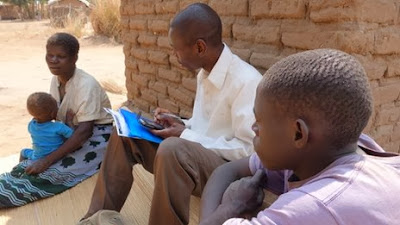
Families are interviewed in the community by trained fieldworkers

Lazaro Cypriano lives in the village of Mzangawa in Mchinji district, central Malawi with his wife Magdalena and their toddler.

The couple lost their first two children.

Their second child died about a year ago, after a series of hospital visits due to fever. It is this death that will be the subject of the verbal autopsy.

'Highly sensitive'

Outside urban areas, one of the main problems for collecting data is finding out when a death has occurred.

To get around this, field reporters from the local community take on the responsibility of alerting the MaiMwana team of people who have died in their area.

This is how Lazaro's family was identified, and the visit now affords him his first opportunity to narrate what happened to his son and have that information recorded.

The interviewer asks the couple standard questions and matches their answers to the choices provided in the application's template.

It's a highly sensitive and skilled job - and one which field interviewer Nicholas Mbwana can see is made easier by using a mobile phone.

"We go to the households, ask about the causes of death - what really happened - and we also record the GPS in order to trace the household in future," he told the BBC.

Dr King says the system is key to the success of the project.

"GPS gives us the location of every household in the district so we can actually plot out on a map where people are dying of what, which means that you could design more sophisticated programs for targeting specific interventions."

The bigger picture

Mobile phone autopsies are being used on a limited scale at present. But the long term aim is to roll out the technique much more widely.

"The beauty of the system is that it's standardised and can be translated into any language you want," says Dr Bird.

"It's important when you're collecting data on a large scale that everyone is answering the same question, so that you know that the results are directly comparable from town to town and country to country."

Interviewees' answers are inputted directly into the mobile phone app

The World Health Organization (WHO) is already supporting the initiative and is working with institutions from the UK to Sweden to develop the technology further.

The data is currently being collected in a range of databases that can be accessed by researchers interested in public health.

As the project grows, researchers from the University of Umea in Sweden will co-ordinate the growing number of translations and the distribution of the technology around the world.

The government in Malawi is already keen to see the results of the project.

"It is important for us as a ministry to know what is killing Malawians out there so that we can plan ahead and put appropriate interventions in place to prevent that - and also to put out health messages," says Dr Charles Mwansambo, Malawi's Health Secretary.

The Ministry of Health has so far only been using information collected from medical facilities, which the health secretary concedes is biased data.

"We need comprehensive data from the hospitals and the community to plan well. We find ourselves planning for the small community that comes to hospital, not realising there is a bigger community out there that we need to budget for," he adds.

Significant inroads

Dr Mwansambo also acknowledges that a cultural practice of burying health documents with the dead makes it difficult to collect important information about deaths.

"When somebody dies people want to forget everything about them - those memories that will remind them of their loved ones. So unfortunately they bury the health passport along with their clothes and other possessions and we lose vital information in the process," he explains.

The health passports are documents issued to parents, which record the birth weight of the baby and its gain over time, as well as which immunizations were administered and when.

An elder at Mzangawa village, Kangkwamba Piri, is already talking to members of his community to drop that cultural practice.

"We've been doing this for a long time but it is wrong. What needs to be done is not to bury the documents and that's what we're encouraging people to do," he says.

For now, it is likely that millions of deaths will still go unnoticed by official figures. But verbal autopsies recorded on mobile phones are making small but significant inroads into solving the problem.

And for and his wife Magdalena, the chance to give information about what killed their child to an official is important.

Magdalena says: "What I have learnt from this interview will help me take care of my third baby so he can be healthy and live long."

Related Article:


Thursday, April 11, 2013

For Malaysia: Bringing Google Apps and Chromebooks to the classroom

Google Blog, Wednesday, April 10, 2013   

As a parent of three kids, I have the same aspirations as many other parents and educators—to provide them with the best opportunities to learn and discover their passions. For many students, the web has become an incredible resource for the classroom, offering tools to work collaboratively, share and research. School systems of all sizes—from a single primary school to an entire country such as the Philippines—have “Gone Google” in their schools and embraced the web to transform education.

Today the country of Malaysia is going a step further by adopting Google Apps for 10 million students, teachers and parents. As part of this initiative they are also deploying Chromebooks to primary and secondary schools nationwide. These efforts to integrate the web are a central part of a national plan (PDF) to reform its educational system.


To deploy technology across a nationwide school system, computers need to be simple, manageable and secure. Chromebooks are ideal for learning and sharing in the classroom—there’s nothing complicated to learn, they boot up in seconds and have virus protection built in. They also offer easy setup and deployment, which means they’re ready to go the moment a student opens the lid and logs in. And with reduced overhead costs, Chromebooks are a cost-efficient option* to deploy technology at scale.

To date, more than 3,000 schools worldwide, from Edina, Minnesota to Point England, New Zealand, have deployed Chromebooks to improve attendance and graduation rates, make learning more fun and enable students to take more ownership for their learning.

The web gives our children and students new opportunities to access the world’s information and work collaboratively. We look forward to working with national and regional leaders to make the most of the web with Google Apps and Chromebooks and help them provide the best opportunities to every student.

Posted by Felix Lin, Director of Product Management

*In research sponsored by Google, research firm IDC found that Chromebooks yield three-year cost of ownership savings of $1,135 per device compared to traditional PCs or tablets, require 69% fewer hours to deploy and 92% fewer hours to manage. Learn more.

Links to this post


Thursday, March 28, 2013

The World’s Languages in Your Pocket (No Internet Required)

Google Translate Blog, Wednesday, March 27, 2013

 Have you ever found yourself in a foreign country, wishing you knew how to say "I'm lost!" or "I'm allergic to peanuts”? The Internet and services like Google Translate can help—but what if you don't have a connection?

 Today we're launching offline language packages for Google Translate on Android (2.3 and above) with support for fifty languages, from French and Spanish to Chinese and Arabic.

You can select [Offline Languages] in the app menu to see all the offline language packages available for download. To enable offline translation between any two languages, you just need to select them in the offline languages menu. Once the packages are downloaded, you're good to go.


While the offline models are less comprehensive than their online equivalents, they are perfect for translating in a pinch when you are traveling abroad with poor reception or without mobile data access.


So go out and explore another language or another culture without worrying about Internet access. There’s a whole world offline out there.

Posted by Minqi Jiang, Associate Product Manager, on behalf of the Google Translate Team

Thursday, March 7, 2013

World's Best Designed iPad News App, Society for News Design

guardian.co.uk, GNM press office, Thursday 7 March 2013

The Guardian and Observer's iPad app has been named as the 'world's best designed iPad news app' by the Society for News Design.

Hundreds of sites from around the world were nominated by users and were reviewed by a panel of judges. Each winner required a unanimous vote.

Judges thought that the experience the app provided was "sublime," with each issue featuring "a jaw-dropping use of photography," as well as the use of simple tools to strike the perfect balance of identity, style and pacing.


"Recalibration of Free Choice"–  Mar 3, 2012 (Kryon Channelling by Lee Caroll) - (Subjects: (Old) Souls, Midpoint on 21-12-2012, Shift of Human Consciousness, Black & White vs. Color, 1 - Spirituality (Religions) shifting, Loose a Pope “soon”, 2 - Humans will change react to drama, 3 - Civilizations/Population on Earth,  4 - Alternate energy sources (Geothermal, Tidal (Paddle wheels), Wind), 5 – Financials Institutes/concepts will change (Integrity – Ethical) , 6 - News/Media/TV to change, 7 – Big Pharmaceutical company will collapse “soon”, (Keep people sick), (Integrity – Ethical)  8 – Wars will be over on Earth, Global Unity, … etc.) - (Text version)

“…6 - The News

Number six. I'll be brief. Watch for your news to change. It has to. When the media realizes that Human Beings are changing their watching habits, they're going to start changing what they produce for you to watch. Eventually, there's going to be something called "The Good News Channel," and it will be very attractive indeed. For it will be real and offset the drama of what is today's attraction. This is what families at night, sitting around the table, will wish to watch. They'll have something where the whole picture of a situation is shown and not just the dramatic parts. You will hear about what's happening on the planet that no one is telling you now, and when that occurs [we have no clock, dear one], it's going to compete strongly with the drama. I keep telling you this. Human nature itself is starting to be in color instead of black and white. Watch for it. And that was number six ….”

Monday, December 10, 2012

Apple Maps glitch could be deadly: Australian police

Yahoo – AFP,  10 December 2012

People queue up to buy Apple's iPhone 5 in Sydney in September 2012.
Australian  police have warned motorists about using the map system on new
 Apple iPhones after rescuing several people left stranded in the wilderness, 
saying the errors could prove deadly

Australian police Monday warned motorists about using the map system on new Apple iPhones after rescuing several people left stranded in the wilderness, saying the errors could prove deadly.

Victoria state police said drivers were sent "off the beaten track" in recent weeks while attempting to get to the inland town of Mildura, being directed instead to the middle of a national park.

"Police are extremely concerned as there is no water supply within the park and temperatures can reach as high as 46 degrees Celsius (114 F), making this a potentially life threatening issue," police said in a statement.

Authorities said tests on the mapping system had confirmed that it lists Mildura, around 500 kilometres (310 miles) northwest of Melbourne, as being in the heart of the Murray Sunset National Park.

This is about 70 kilometres (43 miles) from its actual location.

Six motorists have been rescued in recent weeks from the park after following directions on their Apple iPhones, some of them after being stranded for up to 24 hours without food or water.

Others had walked long distances through dangerous terrain to get reception on their phones.
"If it was a 45-degree day, someone could actually die," Mildura's Local Area Commander Inspector Simon Clemence told state broadcaster ABC.

"It's quite a dangerous situation, so we would be calling for people not to use the new Apple iPhone mapping system if they're travelling from South Australia to Mildura."


Photo illustration of an Australian road sign. Six motorists have been rescued
in  recent weeks in Australia after following directions on their new Apple iPhones,
some of them after being stranded for up to 24 hours without food or water

Apple was not immediately reachable for comment on the issue.

In September the company apologised for its glitch-ridden maps application in the new operating system used by the iPhone 5 and urged customers to use rival programmes while improvements were made.

The iconic US firm developed its own mapping programme included in its new mobile iOS 6 operating system, and in doing so booted off Google Maps, which had been the default programme for Apple devices.

But the new system immediately drew scorn for omitting key landmarks and cities, failing to identify correct locations and distorting views from its images.

Victoria police said they had contacted Apple about the problem and they hoped it could be rectified promptly. In the meantime, they asked motorists in the state to rely on other forms of mapping.

Related Articles: