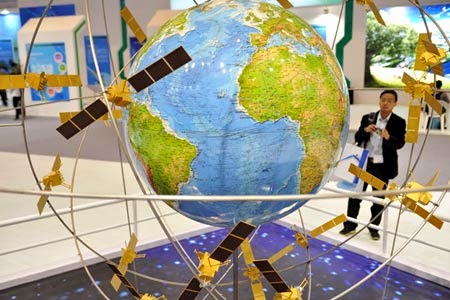
The Internet - The first Worldwide Tool of Unification ("The End of History")

" ... Now I give you something that few think about: What do you think the Internet is all about, historically? Citizens of all the countries on Earth can talk to one another without electronic borders. The young people of those nations can all see each other, talk to each other, and express opinions. No matter what the country does to suppress it, they're doing it anyway. They are putting together a network of consciousness, of oneness, a multicultural consciousness. It's here to stay. It's part of the new energy. The young people know it and are leading the way.... "

" ... I gave you a prophecy more than 10 years ago. I told you there would come a day when everyone could talk to everyone and, therefore, there could be no conspiracy. For conspiracy depends on separation and secrecy - something hiding in the dark that only a few know about. Seen the news lately? What is happening? Could it be that there is a new paradigm happening that seems to go against history?... " Read More …. "The End of History"- Nov 20, 2010 (Kryon channelled by Lee Carroll)

"Recalibration of Free Choice"– Mar 3, 2012 (Kryon Channelling by Lee Carroll) - (Subjects: (Old) Souls, Midpoint on 21-12-2012, Shift of Human Consciousness, Black & White vs. Color, 1 - Spirituality (Religions) shifting, Loose a Pope “soon”, 2 - Humans will change react to drama, 3 - Civilizations/Population on Earth, 4 - Alternate energy sources (Geothermal, Tidal (Paddle wheels), Wind), 5 – Financials Institutes/concepts will change (Integrity – Ethical) , 6 - News/Media/TV to change, 7 – Big Pharmaceutical company will collapse “soon”, (Keep people sick), (Integrity – Ethical) 8 – Wars will be over on Earth, Global Unity, … etc.) - (Text version)

“…5 - Integrity That May Surprise…

Have you seen innovation and invention in the past decade that required thinking out of the box of an old reality? Indeed, you have. I can't tell you what's coming, because you haven't thought of it yet! But the potentials of it are looming large. Let me give you an example, Let us say that 20 years ago, you predicted that there would be something called the Internet on a device you don't really have yet using technology that you can't imagine. You will have full libraries, buildings filled with books, in your hand - a worldwide encyclopedia of everything knowable, with the ability to look it up instantly! Not only that, but that look-up service isn't going to cost a penny! You can call friends and see them on a video screen, and it won't cost a penny! No matter how long you use this service and to what depth you use it, the service itself will be free.

Now, anyone listening to you back then would perhaps have said, "Even if we can believe the technological part, which we think is impossible, everything costs something. There has to be a charge for it! Otherwise, how would they stay in business?" The answer is this: With new invention comes new paradigms of business. You don't know what you don't know, so don't decide in advance what you think is coming based on an old energy world. ..."
(Subjects: Who/What is Kryon ?, Egypt Uprising, Iran/Persia Uprising, Peace in Middle East without Israel actively involved, Muhammad, "Conceptual" Youth Revolution, "Conceptual" Managed Business, Internet, Social Media, News Media, Google, Bankers, Global Unity,..... etc.)


German anti-hate speech group counters Facebook trolls

German anti-hate speech group counters Facebook trolls
Logo No Hate Speech Movement

Bundestag passes law to fine social media companies for not deleting hate speech

Honouring computing’s 1843 visionary, Lady Ada Lovelace. (Design of doodle by Kevin Laughlin)
Showing posts with label Global Networks. Show all posts

Saturday, August 1, 2020

Amazon to invest $10 bn in space-based internet system

Yahoo – AFP, July 31, 2020

Amazon could deliver satellite-based internet service to the US and other parts of
the world without reliable access through its Project Kuiper, which will deploy
some 3,000 satellites (AFP Photo/Philippe LOPEZ)

Washington (AFP) - Amazon says it will invest $10 billion for its planned space-based internet delivery system after winning US regulatory approval to deploy more than 3,000 low-orbit satellites.

The US tech giant said on Thursday it is moving forward with its Project Kuiper, one of several systems planned to bring internet to customers without land-based connections.

Project Kuiper aims to deliver satellite-based broadband services in the United States, and eventually around the world, and may offer connectively for wireless carriers and 5G networks.

Amazon offer no timetable for the project but said it would begin deployment of its 3,236 satellites after the Federal Communications Commission approved the project.

"We have heard so many stories lately about people who are unable to do their job or complete schoolwork because they don't have reliable internet at home," said Amazon senior vice president Dave Limp.

"There are still too many places where broadband access is unreliable or where it doesn't exist at all. Kuiper will change that. Our $10 billion investment will create jobs and infrastructure around the United States that will help us close this gap."

Project Kuiper seeks to deliver high-speed broadband service to places beyond the reach of traditional fiber or wireless networks, including disaster relief.

It will be aimed at individual households, as well as schools, hospitals, businesses and other organizations.

An Amazon statement said the project also aims to "deliver an affordable customer terminal that will make fast, reliable broadband accessible to communities around the world."

Kuiper is one of several projects to deliver internet from space begun over the past decades.

Elon Musk's SpaceX and British-based OneWeb, which filed for bankruptcy earlier this year, are working on similar projects.

Monday, November 11, 2019

Russian e-commerce booms despite economic doldrums

Yahoo – AFP, Andrea PALASCIANO, November 10, 2019

Online retailer Ozon handles over 100,000 packages a day at one of its
 logistics centre in the town of Tver (AFP Photo/Kirill KUDRYAVTSEV)

Moscow (AFP) - Moscow photographer Galina Goryushina says that online shopping has changed her life.

"I've got more time for myself," said the 30-year-old freelancer.

"I don't have to haul heavy shopping bags. And I don't waste money on silly knick-knacks laid out on the store shelves," said Goryushina.

The young woman began shopping online a decade ago when she could not find clothes she liked in Russia and now makes most of her purchases online.

Russia may be a latecomer to the world of online shopping but e-commerce is experiencing explosive growth in the country despite a stagnant economy weighed down by Western sanctions.

Russia's economic growth stood at just 0.7 percent in the first six months of 2019.

Over the same period, the Russian e-commerce market has expanded by 26 percent to 725 billion rubles ($11.3 billion), according to a study by Data Insight, a Russian-based research agency.

The sector is developing rapidly despite numerous logistical challenges in the world's largest country including an often unreliable postal service.

Long distances and low population density make e-commerce an appealing -- and sometimes even the only -- option in Russia.

Even in affluent Moscow, where shopping malls offer a huge variety of consumer goods, many prefer to shop online to avoid the ubiquitous traffic jams.

'Transformative for the country'

One of Russia's biggest online retailers, Ozon, began as an online bookstore -- much like the global giant Amazon -- and later expanded into other types of merchandise.

On a recent tour of Ozon's offices in Moscow's business district, chief executive Alexander Shulgin said the potential for growth in Russia was enormous.

"I am absolutely confident that e-commerce will be absolutely huge in Russia, it's transformative for the country," he said, pointing to Russia's high internet penetration, with 95 million online users.

In the first six months of this year, the number of online orders went up by 44 percent reaching 191 million.

Together with Russia's biggest e-commerce site, Wildberries, and the online pharmacy Apteka.ru, the top trio's business has grown by 107 percent compared to the first half of last year.

Shulgin said that online shopping offered Russians living in remote locations access to millions of products at affordable prices.

"It's just phenomenal how e-commerce improves quality of life for people in small villages and towns," he added.

Besides its huge size, Russia's harsh climate is also seen as a boon for the business.

"When there is rain or snow or it's cold outside, people prefer to shop online, so (Russia) is an ideal country," he said.

Shulgin said the e-commerce market was fragmented and accounted for just 6 percent of total retail.

"So the opportunity for growth is huge," he added.

In a logistics centre in the town of Tver, located around 180 kilometres (111 miles) northwest of Moscow, Ozon employees are busy pushing carts around aisles as they prepare to ship goods to customers across Russia.

"The centre handles over 100,000 packages a day and around 2,000 people work here on a daily basis," said Ivan Popov, deputy logistics manager at Ozon.

In the cities, the company relies on couriers, automated pick-up lockers and drop-off locations.

To ship the packages to remote locations, Ozon has partnered up with the Russian Post.

"They have a branch in every possible location, ideal for smaller villages, they can deliver anywhere," said Shulgin.

Self-made woman billionaire

Ozon's competitor Wildberries has also been growing at breakneck speed in recent years, making its founder one of the country's richest women.

This year its founder, Tatyana Bakalchuk, a 44-year-old mother of four, became the second female billionaire in Russia, according to Forbes.

Bakalchuk, a former English teacher, founded the company in 2004, at the age of 28, in her Moscow apartment while on maternity leave.

She came up with an e-commerce business idea after trying to shop at traditional stores with a newborn.

Initially focusing on shoes and clothing, her business has now expanded into food, books, electronics and health products, offering 15,000 brands.

In March, it became the third most visited e-commerce fashion website in the world, trailing behind H&M and Macy's, according to a study by SEMrush marketing analytics firm.

Already present in ex-Soviet Belarus, Kazakhstan, Kyrgyzstan and Armenia, Wildberries is now aiming for Central Europe and is building a logistics centre in Slovakia.


Wednesday, June 28, 2017

Multinationals hit by global wave of cyberattacks

Yahoo – AFP, Oleksandr Savochenko with Maria Antonova in Moscow and AFP bureaus, June 27, 2017

Ukraine's central bank said a cyberattack hit several lenders in the country,
hindering operations and leading the regulator to warn other financial institutions
to tighten security measures (AFP Photo/Kirill KUDRYAVTSEV)

Kiev (AFP) - A global wave of cyberattacks that began in Russia and Ukraine on Tuesday wrought havoc on government and corporate computer systems as it spread to Western Europe and across the Atlantic.

Several multinational companies said they were targeted, including US pharmaceutical giant Merck, Russian state oil giant Rosneft, British advertising giant WPP and the French industrial group Saint-Gobain.

The first reports of trouble came from Ukrainian banks, Kiev's main airport and Rosneft, in a major incident reminiscent of the recent WannaCry virus.

Some IT experts identified the virus as "Petrwrap", a modified version of the Petya ransomware which hit last year and demanded money from victims in exchange for the return of their data.

But global cybersecurity firm Kaspersky Lab said: "Our preliminary findings suggest that it is not a variant of Petya ransomware as publically reported, but a new ransomware that has not been seen before," which it named "NotPetya".

The cyberattack also recalled a ransomware outbreak last month which hit more than 150 countries and a total of more than 200,000 victims with the WannaCry ransomware.

'Spreading round the world'

The virus is "spreading around the world, a large number of countries are affected," Costin Raiu, a researcher at the Moscow-based Kaspersky Lab said in a Twitter post.

In the United States, Merck was hit as was New York law firm of DLA Piper.

"We confirm our company's computer network was compromised today as part of a global hack. Other organizations have also been affected," Merck said on Twitter.

"It seems to be done by professionals criminals, and I think money is the motivation," said Sean Sullivan, a researcher at the Finnish cybersecurity group F-Secure.

He said that unlike the recent WannaCry attack, this "Petrwrap" attack has sophisticated elements that could make it easier to rapidly infect many more systems.

'Powerful' attack

Ukrainian Prime Minister Volodymyr Groysman wrote on Facebook that the attacks in his country were "unprecedented" but insisted that "important systems were not affected."

However, the radiation monitoring system at Ukraine's Chernobyl nuclear site has been taken offline after it was targeted in the attack, forcing employees to use hand-held counters to measure levels, officials said Tuesday.

The technological systems were working "as usual" at the plant that exploded in 1986, however.

The attacks started around 2:00 pm Moscow time (1100GMT) and quickly spread to 80 companies in Ukraine and Russia, said cybersecurity company Group IB.

The companies affected were hit by a type of ransomware that locks users out of the computer and demands purchase of a key to reinstate access, Group IB said.

The cryptolocker demands $300 in bitcoins and does not name the encrypting program, which makes finding a solution difficult, Group IB spokesman Evgeny Gukov said.

Ukraine's central bank said several lenders had been hit in the country, hindering operations and leading the regulator to warn other financial institutions to tighten security measures.

Banks were experiencing "difficulty in servicing customers and performing banking operations" due to the attacks, the bank said in a statement.

Rosneft said earlier that its servers suffered a "powerful" cyberattack but thanks to its backup system "the production and extraction of oil were not stopped."

The wave of cyberattacks also impacted Maersk, a global cargo shipping company; Saint-Gobain, a French company producing glass and other construction materials; and British-based WPP.

In Amsterdam, the Dutch parcel delivery company TNT, which operates in 200 countries around the world, said its systems had been affected. "We are assessing the situation and are implementing remediation steps as quickly as possible," the company, part of FedEx, said in a statement to AFP.

Signs of sophistication

Experts also said this latest attack could heighten fears that companies may be more vulnerable to cyberattacks than suspected, potentially putting personal data at risk.

"This will undeniably affect trust in these organisations and raise questions of competency," said Louis Rynsard, a director at the corporate communications agency SBC London.

"The long-lasting impact of a cyberattack cannot be overstated," he said.

The fight against cyberattacks has sparked exponential growth in global protection spending, with the cyber security market estimated at $120 billion this year, more than 30 times its size just over a decade ago.

But even that massive figure looks set to be dwarfed within a few years, experts said, after ransomware attacks crippled computers worldwide in the past week.

Thursday, January 7, 2016

Netflix becomes 'global TV network' in 190 countries

Yahoo – AFP, Glenn Chapman, January 6, 2016

Netflix CEO Reed Hastings gives a keynote address, January 6, 2016 at the
Consumer Electronics Show in Las Vegas, Nevada (AFP Photo/Robyn Beck)

Las Vegas (AFP) - Streaming pioneer Netflix said Wednesday it had significantly expanded its global footprint to 190 countries, making its Internet TV service available in 130 new markets including India -- but not China.

Netflix, which began as a mail-order DVD service but is now producing award-winning original content alongside its offering of older shows and movies, launched in 2007. Now, 70 million subscribers pay a monthly fee for unlimited service.

"Today you are witnessing the birth of a new global Internet TV network," co-founder and chief executive Reed Hastings said at the Consumer Electronics Show in Las Vegas.

"With this launch, consumers around the world -- from Singapore to St. Petersburg, from San Francisco to Sao Paulo -- will be able to enjoy TV shows and movies simultaneously -- no more waiting."

"While you have been listening to me talk, the Netflix service has gone live in nearly every country in the world except China, where we hope to be in the future."

Netflix noted in a statement that it "continues to explore options for providing the service" in China, the world's most populous country, where the government censors online content it deems to be politically sensitive.

Other countries or markets without the service are Crimea, North Korea and Syria due to US government restrictions on American companies, Netflix said.

While English is the main language for most of the new markets, Netflix said it has added support for Arabic and Korean, along with simplified and traditional Chinese to the 17 languages it now uses.

"From today onwards, we will listen and we will learn, gradually adding more languages, more content and more ways for people to engage with Netflix," said Hastings.

"We're looking forward to bringing great stories from all over the world to people all over the world."

Following its launch, Netflix first expanded to Canada, and then to Latin America, Europe, Australia, New Zealand and Japan. Until Wednesday, it was available in 60 countries.

The company has been shifting from recycling old shows and movies to producing more original content, with its shows such as "House of Cards" and "Orange Is The New Black."

In 2016, the company plans to release 31 new and returning original series, two dozen original feature films and documentaries, as well as its own stand-up comedy specials and 30 original children's programs.

Netflix is ahead of key rivals in streaming such as Amazon and Hulu, which have also begun to produce original content.

The rapid expansion is likely to impact the bottom line at Netflix. In its most recent quarterly update, the company said that it expects "to run around break-even through 2016 and to deliver material profits thereafter."

For the third quarter, Netflix posted a net profit of $29.4 million on revenues of $1.7 billion. While revenues grew 23 percent from a year ago, profits were halved.

Netflix raised prices in the US and several other countries in the past year, saying it was needed "to improve our ability to acquire and offer high quality content."

Thursday, May 14, 2015

Renewable energy vital for Internet lifestyles: Greenpeace

Yahoo – AFP, Glenn Chapman, May 12, 2015

A Greenpeace report charges utilities with hampering efforts to use renewable
 energy to power data centers needed for services hosted in the cloud (AFP
Photo/Martin Bureau)

San Francisco (AFP) - A Greenpeace report released on Tuesday charged utilities with hampering efforts to use renewable energy to power data centers needed for services hosted in the cloud.

Greenpeace praised moves made by Apple, Google and other Internet titans to fill a skyrocketing demand for electricity with solar, wind or other environmentally-friendly sources but lamented expansion of data center capacity in places where utilities reliant on carbon-spewing coal fuel dominate markets.

"A growing number of companies have begun to create a corner of the Internet that is renewably powered and coal free," the report said in an executive summary.

A Greenpeace activist sets miniature
 windmills in front of Strasbourg's railway
 station during an action aimed at 
increasing public awareness of 
energetical transition on February 11,
2012 (AFP Photo/Frederick Florin)
Internet companies that have committed to being completely powered by renewable energy sources include Apple, Facebook, and Google, according to Greenpeace.

Those commitments have driven growth of renewable power in several key markets, and caused some utilities to invest more heavily in that kind of electricity generation to meet demand, the report stated.

However, some locations that have attracted data center investments are in markets ruled by utilities with generation powered mostly by coal, gases from which are a culprit in climate change.

Examples listed included Duke Energy in North Carolina, Dominion Resources in Virginia, and Taiwan Power Company in Taiwan.

"These utilities represent the biggest obstacles to building a green Internet, and will require collaborative pressure from data center operators and other electricity customers to secure the policy changes needed to open the market up to competitors that offer meaningful options for renewable energy," Greenpeace said.

Apple leads the charge

Apple continued to "lead the charge" in using clean energy to power Internet operations even as the California-based company rapidly expanded, according to the report.

Apple on Sunday announced broadened renewable energy and environmental protection initiatives in China, including a project with the World Wildlife Fund to promote responsible forest management.

The forestland project aims to protect up to a million acres of working forests used for fiber for paper and wood products, according to Apple.

The project is expected to generate as much as 80 million kilowatt hours annually of clean electricity, enough to power about 61,000 Chinese homes.

About 87 percent of Apple's global operations run on renewable energy, and the Sichuan Province solar farms will move the company closer to 100 percent, according to the maker of iPhones, iPads, iPods, Macintosh Computers, and Apple Watch.

Apple continues to "lead the charge" in using clean energy to power Internet 
operations even as the California-based company rapidly expanded, 
according to the report (AFP Photo/Philippe Huguen)

Google is also pushing to rely on renewable energy, but its progress is under threat by monopolies held by coal-using utilities in some data center locations such as Georgia, Singapore, Taiwan, and the Carolinas, according to Greenpeace.

Amazon, Microsoft, eBay, and Oracle were among technology giant's who scored low grades from Greenpeace when it came to green energy deployment and advocacy.

"The magic of the Internet seems almost limitless," Greenpeace said. "But each new internet enabled magic trick means more and more data."

Increasing demand for data, particularly streaming video, and processing power in the cloud means ramped up demand for power by data centers doing the online work.

"While there may be significant energy efficiency gains from moving our lives online, the explosive growth of our digital lives is outstripping those gains," Greenpeace said.

Tuesday, February 24, 2015

African nations face dilemma over digital switch

The UN has set June as the deadline for moving from analog to digital transmission. Only a few African countries seem prepared for the change. Even the largest television markets on the continent are lagging behind.

Deutsche Welle, 23 Feb 2015

A group of people stands near three large satellite dishes in a rural area.
Photo: John Hrusa epa dpa

Staring at a blank TV screen has become a reality for most Kenyans, and many other African TV viewers could face the same fate come June 17. That is the deadline set by the UN's International Telecommunication Union (ITU) for television programs to be transmitted only digitally.

After the deadline, satellite dishes and antennas will receive their signals via a different technology. Theoretically, it will be possible to receive many more channels and enjoy improved image quality.

There is a story behind Kenya's black screens. President Uhuru Kenyatta's government ordered a consortium of four major television networks to be blocked from broadcasting in analog. This happened after they refused to change their signals to digital. The media houses argued that they were not ready yet, and now they are in court trying to push for one hundred more days to prepare for the digital transition.

Apart from Nigeria and South Africa, Kenya is one of the largest television markets in Africa.

The Standard Group,one of Kenya's leading media house, says
it needs more time for the switchover

All three countries are not ready for the switchover, says Mike Jensen, an IT specialist with the Association for Progressive Communications (APC) based in South Africa. "The Kenyan situation is probably the worst-case scenario on the continent; South Africa is pretty close," Jensen said. "In Nigeria, only one state has made the switch," Jensen told DW.

Nationwide coverage after the switchover to digital broadcasting is by no means ensured in African countries. As in Kenya, it is often about money. The change is costly for governments and citizens alike, the APC states on its website, which seeks to create an awareness of the issue.

Television viewers will usually need a decoder, which costs about $50 (44 euros), to decode the digital signal. Moreover, television companies will have to dig deep into their pockets to be able to broadcast their programs using the new technology.

Tanzania a digital model

Vera Moses, a Tanzanian viewer, says she is happy with the digital reception. "The quality of the pictures is good," she told DW in an interview.

Tanzania is one of three countries that has already largely switched to wide-band Digital Video Broadcasting (DVB). "In Dar es Salaam we already switched off analog transmission at the end of 2012," John Nkoma, the director of Tanzania's Communications Regulatory Authority (TCRA), told DW. Most cities are now receiving programs via DVB-T, which is terrestrial digital broadcasting via antenna. The remote parts of Tanzania receive broadcasts via satellite.

Dar es Salaam has already gone digital
It took some persuasion to convince citizens and businesses of the merits of the new system, Nkoma said, as he revealed two secrets to Tanzania's success: Firstly, decoders were taxed less. "The price for the decoders is artificially low," Nkoma said, "so they have become affordable." Tanzanians can get a decoder for $30.

Secondly, user habits were taken into consideration. "The public was used to free-to-air channels, so we required that in the digital broadcasting platform there would be the five popular channels of this country and those would be available as free channels." Viewers whose subscriptions expire would have these five channels to fall back on.

Market interests

But according to APC's Mike Jensen, that is not the whole story. Tanzania and neighboring Rwanda had forced the switchover on the public by shutting off the analog signal. Of course, there were citizens in both countries who simply could not afford the necessary equipment, Jensen said.

He thinks governments should guarantee a realistic compensation for the costs. The price of a decoder, Jensen said, was also a big issue in Mauritius. The government ordered large amounts of cheap decoders from China. Many of which had defects.

Satellite transmission is also to be digitalized

Jensen also does not understand the date the ITU has chosen. He estimates that by then only six countries may succeed in formally completing the switchover.

Germany has already changed to digital broadcasting, and so have most of the other industrialized nations. But Latin America has planned the switchover for as late as 2020.

Jensen says African telecommunications companies pushed for the early date for Africa. These companies, he said, were the only ones to profit from such a date, because they wanted to monopolize television broadcasting.

Sunday, November 23, 2014

Its time for the internet to help small businesses: Jack Ma

Want China Times, Xinhua 2014-11-22

Jack Ma speaks at the opening of the First World Internet Conference,
Nov. 19. (Photo/Xinhua)

Jack Ma, founder of Alibaba group, described on Thursday how the company is exploring ways to help small businesses not only in China, but all around the world.

The three-day First World Internet Conference opened on Wednesday in the scenic river town of Wuzhen with roughly 1,000 internet professionals in attendance, representing more than 100 countries and regions. It was in this beautiful setting that Ma said, "traditionally, all we think about is how to sell products to others and how to get money out of the pockets of consumers."

"The internationalization of Alibaba's business requires us to ponder the issue of how to help others sell their products to us. China's rapidly rising middle class is posting a huge demand for foreign products." In February Alibaba launched Tmall International, dealing mainly in commodities produced or sold in overseas markets.

Ma believes that in the global village, old trade modes will be transformed, and, within the WTO framework, the rules of game are set by governments. The market is frequently at the mercy of international relations. The internet has made it possible for a business world built by the entrepreneurs to evolve on the basis of the market economy and unencumbered by political squabbling.

In September, Alibaba was the source of the world's biggest initial public offering.

Thursday, September 4, 2014

3DHubs Raises $4.5 Million To Make Local 3D Printing Global

TechCrunch, John Biggs, 3 Sep 2014

3DHubs, a 3D printer matching service, has raised a $4.5 million Series A to help bring their local 3D printing system to the world. The service, which allows you to find and order 3D prints from printers in your area, is similar to other services like MakeXYZ and 3DLt but is already available overseas.

Founded by former 3D Systems employees Brian Garret and Bram de Zwart, the site was one of the first global 3D printing solutions. They’ve processed over 30,000 3D prints and have about 7,100 printers in 140 countries. To use the service, you simply choose your area, upload a model, and ask for a quote. The 3D printer owner then prints things out and gets it to you via post or sneaker net.


It’s a tough market but the team prides themselves on speed.

“We’re very fast and average delivery time has dropped to 1.2 days from submission to pickup/shipping,” said Garret. “Competitors like Shapeways still take about a week for their fastest materials, and much longer for special materials.”

They’ve also worked up some excellent partnerships and are already embedded as a service provider for some 3D modeling products.

“We’ve got partnerships in place with Autodesk (direct print button to our API) as well as consumer brands like Fairphone. Through these partnerships we drive about 40% of our orders, this is where we see most of the growth in the coming year,” said Garret.

“Bram and I started 3D Hubs out of frustration that existing 3D printing services weren’t living up to the promise of 3D Printing. As soon as we launched, the idea really resonated with printer owners around the world who enjoy printing, but often run out of things to print for themselves,” he said. “3D Hubs offers them a way to earn money and collaborate on cool maker projects.”

The Series A is led by Balderton Capital. Mark Evans, General Partner at Balderton Capital, will join the 3D Hubs board. The company is opening new offices in New York at the Brooklyn Navy Yard and will improve its API penetration. “We are developing new features that will make the experience of ordering a personalized 3D print similar to traditional e-commerce platforms,” said Garret.

Printing and selling small batch hardware is going to be the future. These guys are right at the cusp. It’s definitely a crowded space, though, so it looks like they’re going to have to put all four million of those Series A dollars to work.

Thursday, June 26, 2014

Russia, China to combine efforts in satellite battle with US

Want China Times, Staff Reporter 2014-06-26

A model of China's Beidou satellite navigation system on display
at the Zhuhai Airshow, Nov. 14, 2012 (Photo/Xinhua).

Russia and China are likely to sign a cooperation pact regarding ground operation stations for Russia's GLONASS satellite and China's Beidou satellite, reports Huanqiu, the website of China's nationalistic tabloid Global Times, citing Sergei Savelyev, deputy head of the Russian space agency Roscosmos.

Savelyev said that Russia expects an agreement with China, which will allow the countries to build three ground operational stations in each other's territory, with the number potentially increasing in the future.

At the St Petersburg International Economic Forum 2014 held in late May, Savelyev also said that Russia is preparing to discuss construction of GLONASS ground operation stations with both China and India and expects to reach an agreement of equal number construction by the end of the year.

The Moscow-based Voice of Russia reported that the number may be more than three, as China initially proposed setting up about a dozen Beidou stations in Russia from the Urals to the Far East, and to host a similar number of GLONASS stations.

A Russian researcher told Huanqui that China and Russia are highly likely to cooperate in a joint satellite navigation system, given that they share a common competitor — the US Global Positioning System (GPS). The wise choice would be for Beijing and Moscow to install each other's devices on the counterparts satellites, the researcher said.

During the 2nd Technoprom International Forum held in Novosibirsk in Russia on June 5-6, Russian deputy prime minister Dmitry Rogozin said that cooperation between Russia and China in the field will not be limited to ground operational stations, but will also include reception devices and related infrastructure. "Our system is more suitable for northern, polar latitudes. The Chinese system is more southern. Their complementary natures would result in a biggest and most powerful competitor to any navigation system," he said.

Meanwhile, Sergei Ivanov, chief of staff of the Presidential Administration of Russia, said that in addition to ground operational stations in China, Russia plans to construct 50 GLONASS ground operation stations with 36 countries. He said that negotiations with Nicaragua, Vietnam, Iran and Indonesia are underway, while agreements with Cuba and Spain have already been reached.

Roscosmos also proposed to construct six ground operational stations in the US, but the plan was turned down due to national security concerns, while the US has already set up 11 GPS stations on Russian soil.

However, Russia announced in May that it would suspend the operation of all 11 GPS stations from June 1 due to poor progress in Russia-US talks over the construction of Russian ground stations in the US. The GPS ground operational stations will be permanently shut on September 1 if the two countries fail to reach a consensus by then, according to Huanqiu.

Pope has most clout on Twitter: study

Cent News - AFP, Jonatham Fower, 2014-06-25

Photo Credit: Alain Jocard/AFP

Switzerland - Pope Francis has by far the most clout of any world leader on Twitter because he is so widely retweeted, a study of political use of the social network showed on Wednesday.

With 14 million followers for the nine different language versions of his @Pontifex account, the cyber-savvy pontiff boasts just a third of those notched up by US President Barack Obama.

But that it not the key measure, said Matthias Luefkens, who steers the annual Twiplomacy survey.

"It's not the number of followers which is really important, but the reach, the engagement," he said.

The real benchmark is tweets retweeted by followers to their own network.

Pope Francis wins hands down, with his Spanish-language tweets retweeted more than 10,000 times on average, and his English-language tweets, over 6,400 times.

Obama's 2012 election victory tweet -- a photograph of him embracing First Lady Michelle Obama and the words "Four more years" -- was retweeted a massive 806,066 times.

But on average, @BarackObama gets 1,400 retweets.

Obama's use of social media is credited as a key factor in his landmark 2008 election.

The @BarackObama account, created in 2007, has 43.7 million followers, but is not a US presidential feed and is run by his political campaign staff.

The official @WhiteHouse account has over 4.9 million followers, putting it fifth in the global pecking order, just behind the account of India's new Prime Minister Narendra Modi, and Indonesia's President Susilo Bambang Yudhoyono, who has five million.

@White House was narrowly overtaken on Wednesday by @narendramodi.

"Modi's seen a stratospheric rise," said Luefkens.

Modi, the 63-year-old son of a low-caste tea seller, distances himself from the Delhi elite.

But he is notably tech-aware and has won plaudits from Twitter-watchers for his strategic deployment of it.

Indian officialdom's social media use is a hot topic, as Modi seeks to promote Hindi as the government's official language online, sparking stiff opposition.

While he speaks mostly in Hindi, used by some 40 percent of Indians, Modi's tweets are always in English, preferred for business in a nation with 22 official languages.

Modi, elected in May in a landslide vote, scored 24,000 retweets for his own "India has won!" victory message.

Otherwise, he averages 557.

Huge impact

Luefkens is a social media expert at communications firm Burson-Marsteller, which produces the Twiplomacy study.

He said that while television remains the key channel to hit the widest audience, Twitter is an increasingly-powerful tool.

"It helps you to broadcast, and if you broadcast to the right audience, that has huge impact," he said.

The social network enables politicians to create a sense of intimacy and even to interact with one another in public -- sometimes in an undiplomatic manner, seen in a Ukraine-themed tweet fight between the Russian foreign ministry and leaders from Estonia and Sweden.

Twitter is also a tool for leaders to follow one another mutually -- a statement in itself.

France's foreign minister follows 91 peers and world leaders who return the favour via his @LaurentFabius account, putting him at the top of the Twiplomacy table.

Next was the EU's foreign service account @eu_eeas, with 71 mutual connections, and the Swedish foreign minister, with 68 via his @CarlBildt account.

The @WhiteHouse and @BarackObama only follow three peers: the prime ministers of Russia and Norway, and the British government.

Despite taking to Twitter with gusto, politicians are light years behind celebrities.

Top-ranked stars' accounts include @justinbieber with 52.5 million followers, beaten by @katyperry, who has 54 million.

jwf/nl/lc

Pope Francis poses with young people in the Church of Saint Augustine in Rome
on August 28, 2013 (Osservatore Romano/AFP/File, Francesco Sforza)

Related Articles:


‘The internet is a gift from God’ - Pope Francis

Philippine priests swap sermons for 'selfies'


The Internet  - The first Worldwide Tool of Unification ("The End of History")

" ... Now I give you something that few think about: What do you think the Internet is all about, historically? Citizens of all the countries on Earth can talk to one another without electronic borders. The young people of those nations can all see each other, talk to each other, and express opinions. No matter what the country does to suppress it, they're doing it anyway. They are putting together a network of consciousness, of oneness, a multicultural consciousness. It's here to stay. It's part of the new energy. The young people know it and are leading the way.... "

" ... I gave you a prophecy more than 10 years ago. I told you there would come a day when everyone could talk to everyone and, therefore, there could be no conspiracy. For conspiracy depends on separation and secrecy - something hiding in the dark that only a few know about. Seen the news lately? What is happening? Could it be that there is a new paradigm happening that seems to go against history?... " Read More …. "The End of History"- Nov 20,2010 (Kryon channelled by Lee Carroll)


"Recalibration of Free Choice"–  Mar 3, 2012 (Kryon Channelling by Lee Carroll) - (Subjects: (Old) SoulsMidpoint on 21-12-2012, Shift of Human Consciousness, Black & White vs. Color, 1 - Spirituality (Religions) shifting, Loose a Pope “soon”, 2 - Humans will change react to drama, 3 - Civilizations/Population on Earth,  4 - Alternate energy sources (Geothermal, Tidal (Paddle wheels), Wind), 5 – Financials Institutes/concepts will change (Integrity – Ethical) , 6 - News/Media/TV to change, 7 – Big Pharmaceutical company will collapse “soon”, (Keep people sick), (Integrity – Ethical)  8 – Wars will be over on Earth, Global Unity, … etc.) (Text version)

“…  1 - Spirituality (Religions)

Number one: Spirituality. The systems of spiritual design on your planet are starting to change. This is not telling you that certain ones are going to go away. They're simply going to change. Some of the largest spiritual systems, which you would call organized religion on the planet, are shifting. They're going to shift away from that which is authority on the outside to authority on the inside. It will eventually be a different way of worship, slowly changing the rules while keeping the basic doctrine the same.

The doctrine of the Christ has always been to find the God inside. The teachings were clear. The examples of the miracles were given as an example of what humans could do, not to set a man up for worship as a God. So when that has been absorbed, the teaching of the Christ can remain the teaching of the Christ. It simply changes the interpretation.

The teachings of the great prophets of the Middle East (all related to each other) are about unity and love. So once the holy words are redefined with new wisdom, the Human changes, not the words of the prophets. In fact, the prophets become even more divinely inspired and their wisdom becomes even more profound.

You're going to lose a pope soon. I have no clock. Soon to us can mean anything to you. The one who replaces him may surprise you, for his particular organization will be in survival mode at that point in time. That is to say that fewer and fewer are interested in starting the priesthood. Fewer and fewer young people are interested in the organization, and the new pope must make changes to keep his church alive. That means that his organization will remain, but with a more modern look at what truly is before all of you in a new energy. It is not the fall of the church. It is instead the recalibration of the divinity inside that would match the worship that goes on. It's a win-win situation. The new pope will have a difficult time, since the old guard will still be there. There could even be an assassination attempt, such is the way the old energy dies hard. That is number one. Watch for it. It's a change in the way spiritual systems work. It's a realignment of spiritual systems that resound to a stronger truth that is Human driven, rather than prophet driven. …”