The Internet - The first Worldwide Tool of Unification ("The End of History")

" ... Now I give you something that few think about: What do you think the Internet is all about, historically? Citizens of all the countries on Earth can talk to one another without electronic borders. The young people of those nations can all see each other, talk to each other, and express opinions. No matter what the country does to suppress it, they're doing it anyway. They are putting together a network of consciousness, of oneness, a multicultural consciousness. It's here to stay. It's part of the new energy. The young people know it and are leading the way.... "

" ... I gave you a prophecy more than 10 years ago. I told you there would come a day when everyone could talk to everyone and, therefore, there could be no conspiracy. For conspiracy depends on separation and secrecy - something hiding in the dark that only a few know about. Seen the news lately? What is happening? Could it be that there is a new paradigm happening that seems to go against history?... " Read More …. "The End of History"- Nov 20, 2010 (Kryon channelled by Lee Carroll)

"Recalibration of Free Choice"– Mar 3, 2012 (Kryon Channelling by Lee Carroll) - (Subjects: (Old) Souls, Midpoint on 21-12-2012, Shift of Human Consciousness, Black & White vs. Color, 1 - Spirituality (Religions) shifting, Loose a Pope “soon”, 2 - Humans will change react to drama, 3 - Civilizations/Population on Earth, 4 - Alternate energy sources (Geothermal, Tidal (Paddle wheels), Wind), 5 – Financials Institutes/concepts will change (Integrity – Ethical) , 6 - News/Media/TV to change, 7 – Big Pharmaceutical company will collapse “soon”, (Keep people sick), (Integrity – Ethical) 8 – Wars will be over on Earth, Global Unity, … etc.) - (Text version)

“…5 - Integrity That May Surprise…

Have you seen innovation and invention in the past decade that required thinking out of the box of an old reality? Indeed, you have. I can't tell you what's coming, because you haven't thought of it yet! But the potentials of it are looming large. Let me give you an example, Let us say that 20 years ago, you predicted that there would be something called the Internet on a device you don't really have yet using technology that you can't imagine. You will have full libraries, buildings filled with books, in your hand - a worldwide encyclopedia of everything knowable, with the ability to look it up instantly! Not only that, but that look-up service isn't going to cost a penny! You can call friends and see them on a video screen, and it won't cost a penny! No matter how long you use this service and to what depth you use it, the service itself will be free.

Now, anyone listening to you back then would perhaps have said, "Even if we can believe the technological part, which we think is impossible, everything costs something. There has to be a charge for it! Otherwise, how would they stay in business?" The answer is this: With new invention comes new paradigms of business. You don't know what you don't know, so don't decide in advance what you think is coming based on an old energy world. ..."
(Subjects: Who/What is Kryon ?, Egypt Uprising, Iran/Persia Uprising, Peace in Middle East without Israel actively involved, Muhammad, "Conceptual" Youth Revolution, "Conceptual" Managed Business, Internet, Social Media, News Media, Google, Bankers, Global Unity,..... etc.)


German anti-hate speech group counters Facebook trolls

German anti-hate speech group counters Facebook trolls
Logo No Hate Speech Movement

Bundestag passes law to fine social media companies for not deleting hate speech

Honouring computing’s 1843 visionary, Lady Ada Lovelace. (Design of doodle by Kevin Laughlin)
Showing posts with label GPS. Show all posts

Monday, August 1, 2016

Use the Gospel as your GPS, pope tells huge mass in Poland

Yahoo – AFP, Ella Ide, July 31, 2016

Pope Francis looks on during a mass in the Campus Misericordiae in Brzegi,
near Krakow on July 31, 2016 at the end of the World Youth Day

Pope Francis celebrated mass Sunday with over 1.5 million pilgrims in a vast sun-drenched field in Poland, wrapping up an emotionally charged trip with some choice technological metaphors.

In a nod to today's internet-dominated world, Francis urged the faithful, who had travelled to Poland from all over the world, to "download the best link of all, that of a heart which sees and transmits goodness without growing weary".

"Make the Gospel your own, so that it can serve as a satnav for you on the highways of life," he said during the very spirited service.

Even the music was given the techno treatment, with youngsters, nuns and even some bishops leaping and twirling to hymns beefed up with a thumping dance beat.

High-spirited teenagers, boy scouts, priests and families had camped under the stars in the vast "Campus Misericordiae" (Field of Mercy) near the city of Krakow ahead of the final mass of a week-long Catholic festival.

Francis encouraged the assembled worshipers to be dreamers who believe "in a new humanity", one that "rejects hatred between peoples" and "refuses to see borders and barriers".

The trip's final festivities were attended by "between 2.5 and 3.0 million people," 2016 World Youth Day spokesperson Anna Chmura told AFP. Polish police put the number at "over 1.5 million."

Hundreds of thousands of people had streamed to the grassy site on Saturday with folding chairs, sleeping bags, umbrellas and sun-hats.

Graphic showing details of World Youth Day, to which Pope Francis will 
travel July 25 - 31

'Trip of a lifetime'

"This is the trip of a lifetime, for me and my whole family," said 29-year-old Mexican pilgrim Isaac Victoria, as volunteers handed out bottles of water to the thirsty crowd.

At the evening vigil on Saturday, Francis warned that today's technology also had its dangers, chastising "drowsy and dull kids who confuse happiness with a sofa", and urging them to get out and live life rather than spending it glued to their smartphones.

Francis announced that the next World Youth Day would be held in Panama in 2019, before flying back to Rome Sunday evening.

Latin America's first pontiff had faced stiff competition at the start of his five-day trip with the memory of immensely popular Polish pope John Paul II, whom Catholics recognise as a saint. But Francis quickly made the festivities his own.

After visiting the Nazi death camp in Auschwitz, he warned that the cruelty seen there "did not end" with World War II.

The "world is at war", Francis said, but the way to "overcome fear" was to welcome people fleeing conflicts and persecution -- a message with particular resonance in Poland, which has taken a hard line against refugees.

On Saturday he prayed for God to rid the world of the "devastating wave of terrorism".

"In these dangerous times, he is convincing people not to be afraid to open up," pilgrim Kasia Czajka, 40, said.

"While John Paul II was especially focused on the young, Francis is for all people in need".

Catholic faithful wait for the arrival of Pope Francis on July 31, 2016 in
the vast "Campus Misericordiae" near the Polish city of Krakow

'Multiculturalism as opportunity'

The head of the world's 1.2 billion Roman Catholics cracked joke after joke with young people gathered nightly beneath his window, cranking up the party spirit at an event dubbed "the Catholic Woodstock".

The medieval centre of Krakow has been overrun all week by flag-waving groups from China to Samoa and Mexico, who were entertained between masses with concerts, break-dancing and football matches.

But Friday was a day of mourning as Francis walked silently through the notorious wrought-iron "Arbeit Macht Frei" (Work Sets You Free) gate at the Auschwitz-Birkenau camp, where 1.1 million people were murdered.

Freeing himself from the imposing security laid on for his visit, Francis sat on a bench among the trees and bowed his head in prayer before meeting Holocaust survivors and Catholics who had helped save Jews.

"Lord, have mercy on your people. Lord, forgive so much cruelty," the pope wrote in a memorial book.

In a heartfelt appeal to the world's young, he said it was up to them to fight xenophobia and "teach us how to live in diversity, in dialogue, to experience multiculturalism not as a threat, but an opportunity".

Saturday, July 25, 2015

WTO strikes 'landmark' deal to cut tariffs on IT products

Yahoo – AFP, Ben Simon, 24 July 2015

WTO director Roberto Azevedo says a "landmark" deal has been reached to 
cut tariffs on some information technology products (AFP Photo/Roslan Rahman)

Geneva (AFP) - Major exporters of information technology on Friday agreed to cut global tariffs on more than 200 products, in the first such deal struck by the World Trade Organization in nearly two decades.

The pact which came after three years of frequently-stalled negotiations, covers products ranging from video games to touch screens and GPS navigation systems.

In all, the 201 products covered account for roughly $1.3 trillion (1.18 trillion euros) or seven percent of annual global trade.

"Today's agreement is a landmark," WTO Director General Roberto Azevedo said in a statement, describing the accord as "the first major tariff cutting deal" at the organisation in 18 years.

The European Union Trade Commissioner Cecilia Malmstrom described the deal -- which was initiated and brokered by the EU -- as "a great deal for consumers, and for companies big and small".

While the full terms of the agreement will not be released until next week, the WTO said the highlights include the elimination of "the majority of tariffs" on a diverse range of products within three years.

The trade value of the IT products covered amounts to more than the "trade in automotive products — or trade in textiles, clothing, iron and steel combined," Azevedo.

While only 54 WTO member-states took part in the talks, all 161 nations that make up the organisation can benefit from the outcome, the WTO said.

The EU said an additional, "limited" number of countries is expected to confirm its participation in the deal in the coming days.

The tariff reductions are set to start in 2016, but participating countries must by the end of October submit a draft schedule spelling out their plans to meet the terms of the deal.

Logjam broken

The agreement is an expansion of a pact reached in 1996 by 81 WTO members, known as the Information Technology Agreement (ITA).

In 2012, member states resolved that the ITA needed to be revised because the world's most valuable IT products had been invented after 1996.

But there were considerable hurdles to striking a broader agreement, notably differences between the United States and China.

There were reports that China was fighting to exclude about 60 new product categories, including certain next-generation silicon chips.

US President Barack Obama (L) and Chinese President Xi Jinping (R) drink
 a toast at a lunch banquet in the Great Hall of the People in Beijing on 
November 12, 2014 (AFP Photo/Greg Baker)

In November 2014, President Barack Obama said in Beijing that the two sides had "reached an understanding" on moving the talks forward.

The WTO said that the deal finalised on Friday has provisions to expand the list of products covered, with changes possibly needed "to reflect future technological development."

Lower prices, more jobs

The WTO chief claimed the agreement was set to have "a huge impact" by lowering prices, creating jobs and boosting economic growth worldwide.

For the EU's Malmstrom, much of the immediate benefit was likely to be felt by smaller producers.

"This deal will cut costs for consumers and business – in particular for smaller firms, which have been hit especially hard by excessive tariffs in the past," she said.

Saturday, November 15, 2014

Google joins fight against illegal fishing

Yahoo – AFP, 14 Nov 2014

One of the challenges in tackling illegal fishing has been the lack of jurisdiction
on the high seas (AFP Photo/Joel Nito)

Technology giant Google has taken the battle against illegal fishing online, with the company unveiling a tool in Australia on Friday that harnesses satellite data to track thousands of boats in real time.

A prototype interactive tool, which was developed in conjunction with environmental activists SkyTruth and marine advocacy group Oceana, was unveiled at the once-a-decade World Parks Congress in Sydney.

The tool is the latest salvo from environmentalists against illegal fishing, which is currently estimated by the Global Ocean Commission to cost the world economy up to US$23.5 billion a year.

An office worker checks out a map on 
Google's satellite image service, in Hong
 Kong, on October 18, 2005 (AFP Photo/
Laurent Fievet)
"While many of the environmental trends in the ocean can be sobering, the combination of cloud computing and massive data is enabling new tools to visualise, understand and potentially reverse these trends," Brian Sullivan of Google's Earth Outreach and Oceans section said.

The tool uses data points from the Automatic Identification System network, which picks up GPS broadcasts of a vessel's location to map movements.

The prototype has tracked just over 3,000 fishing vessels, with a public tool set to be released down the track.

SkyTruth said the system, which will only monitor fishing vessels, would make activities usually invisible to the wider public easily viewable.

"So much of what happens out on the high seas is invisible, and that has been a huge barrier to understanding and showing the world what's at stake for the ocean," SkyTruth's president and founder John Amos said.

"Satellite data is allowing us to make human interaction with the ocean more transparent than ever before."

The Global Ocean Commission, an independent panel launched in February 2013, said evidence showed seas have been fished to dangerously low levels, with 90 percent of the world's large fish stocks -- such as tuna and swordfish -- already gone.

The commission said one of the challenges in tackling illegal fishing was the lack of jurisdiction on the high seas.

While the high seas make up 64 percent of the ocean's total surface area, they fall beyond national jurisdictions and suffer from a lack of oversight, the organisation said.

The World Parks Congress, which is being held in Sydney until November 19, has drawn thousands of delegates and is set to lay out a global agenda for protected areas for the next decade.

Related Article:


Sunday, August 31, 2014

Indian start-up launches shoes that show you the way

Yahoo – AFP, Annie Banerji, 31 Aug 2014

Krispian Lawrence, CEO of Ducere Technologies, tries on a pair of GPS-enabled
 smart sports shoes called LeChal in his office in Hyderabad on August 11, 2014 (AFP 
Photo/Noah Seelam)

"Wizard of Oz" heroine Dorothy only had to click her ruby red slippers together and they would spirit her home to Kansas.

Now, an Indian high-tech start-up is promising to do the same in real life with a new, GPS-enabled smart sports shoe that vibrates to give the wearer directions.

The fiery red sneakers, which will also count the number of steps taken, distance travelled and calories burned, will go on sale in September under the name LeChal, which means "take me along" in Hindi.

Krispian Lawrence, CEO of Ducere
Technologies, holds the inner sole of a pair
of GPS-enabled smart sports shoes called
LeChal at his office in Hyderabad on
August 11, 2014 (AFP Photo/Noah Seelam)
The shoes come with a detachable Bluetooth transceiver that links to a smartphone app to direct the wearer using Google maps, sending a vibrating signal to indicate a left or right turn.

They are the brainchild of 30-year-old Krispian Lawrence and Anirudh Sharma, 28, two engineering graduates who founded their tech start-up Ducere in a small apartment in 2011 with backing from angel investors and now employ 50 people.

"We got this idea and realised that it would really help visually challenged people, it would work without any audio or physical distractions," said Lawrence in an interview with AFP.

"But then we were trying it out on ourselves and suddenly we were like, 'wait a minute, even I would want this,' because it felt so liberating not having to look down at your phone or being tied to anything."

"The footwear works instinctively. Imagine if someone taps your right shoulder, your body naturally reacts to turn right, and that's how LeChal works."

Growing sector

Smart shoes aimed at specific demographic markets -- such as dementia sufferers and children whose parents want to keep track of their movements -- are already commercially available.

But Lawrence and Sharma believe theirs will be the first to target mass-market consumers, and have focused on creating stylish rather than purely functional footwear.

As well as the red sneaker, they are marketing an insole to allow users to slip the technology into their own shoes.

"Earlier, wearable technology was always seen as machine-like, nerdy glasses or watches, but now that is changing," said Lawrence.

They say they have 25,000 advance orders for the shoes, which will retail at between $100 and $150.

Demand has so far mostly been through word of mouth and through the lechal.com website. But the company is in talks with retailers to stock the shoes ahead of the holiday season in India and the United States.

It forecasts it will sell more than 100,000 pairs of the shoes, which are manufactured in China, by next April.

Wearable technology is a growing global sector. Market tracker IDC forecast in April that sales would triple this year to 19 million units worldwide, growing to 111.9 million by 2018.

Krispian Lawrence,CEO of Ducere 
Technologies, holds a pair of GPS-enabled
 smart sports shoes called LeChal at his 
office in Hyderabad on August 11, 2014
(AFP Photo/Noah Seelam)
The industry's rapid growth has given rise to fears about privacy, although Ducere says it will record no data on users and maintains robust security.

The company still hopes its product will be useful for visually impaired people, and experts at the L.V. Prasad Eye Institute in the southern city of Hyderabad are testing its suitability.

"It's a perfect intuitive wearable item. You may forget to wear a belt or a helmet, but shoes you can never leave the house without," said Anthony Vipin Das, a doctor at the institute.

"LeChal solves orientation and direction problems, it's a good assistant to the cane."

Possible problems include battery failure or loss of Bluetooth connectivity, which Das says could be fixed by providing a live feed of a user's position to a friend or relative, with their consent.

The company says it could use a portion of any future profits to subsidise the shoes for disabled users.

For all the shoes' high-tech features, Lawrence's favourite thing is that he no longer loses his phone -- if the wearer moves too far from his or her phone, the shoes buzz to warn them.

"I'm a very forgetful person and the best part is that the shoes don't let you forget your phone," he said.

Sunday, June 29, 2014

With new tech tools, precision farming gains traction

Yahoo – AFP, Rob Lever, 29 June 2014

Andrew Isaacson watches from a tractor in a corn field as screens show where
 he has fertilized at the Little Bohemia Creek farm on June 17, 2014 in Warwick, 
Maryland (AFP Photo/Brendan Smialowski)

Warwick (United States) (AFP) - At Little Bohemia Creek Farm, the tractor pretty much drives itself, weaving through rows of corn using GPS technology as it injects carefully dosed amounts of fertilizer.

Farm employee Andrew Isaacson sits in the cab -- his main job is to monitor computer screens that control the vehicle and sprayer.

"I just turn it around at each end," he says.

A trench made for injecting liquid fertilizer
 is seen between rows of corn at the Little
 Bohemia Creek farm June 17, 2014 in
 Warwick, Maryland (AFP Photo/Brendan
 Smialowski)
With computers guiding field operations "it makes it easier in some ways but at the same time it makes it harder. You have to put more information in".

The farm on Maryland's eastern shore is part of a growing "precision agriculture" movement that uses high-tech tools to replace seat-of-the-pants farming.

GPS auto-steered tractors cut down or eliminate overplowing and overlap that wastes fuel and time. Other technologies can sense just how much water is needed in a field to cut irrigation costs.

At Little Bohemia Creek, the tractor's sensors gauge the health of various segments of a field to deliver fertilizer and other chemicals more efficiently, which has an environmental benefit.

"This technology allows for more intricate data collection to make decisions," says Rich Wildman of the agricultural consulting firm Agrinetix, which provides technology advice at the farm.

This permits the farmer to "do more fertilization or seed planting to match the needs of a field within an inch variation," he said.

Various studies suggest farmers can save between 10 to 20 percent on fertilizer and chemicals, while improving yields.

- Farming in the cloud -

Little Bohemia Creek owner Jon Quinn, 48, is using for the first time this year the system called GreenSeeker, from California tech firm Trimble.

"I don't know if I'm using less nitrogen, but I'm putting it in the right place," Quinn explained.

If that holds true, the fertilizer will mainly be absorbed by the corn instead of running off into nearby rivers.

Paul Spies of the Chester River Association, an environmental group, said Quinn is one of a handful of farmers in the pilot project, which aims to show the benefits of this technology.

"You're asking farmers to alter what they have been doing for years," Spies said. "They want to see proof that it will work."

Quinn also participates in a "precision planting" project with Monsanto, using data from his field to determine how seeds fare in different soil types.

"I download it to my iPad, and it goes to the cloud so they can see it," he said.

These technologies mean farmers need to crunch big data.

A sensor that uses visible and invisible
light to judge crop health is used at the
Little Bohemia Creek farm on June 17,
 2014 in Warwick, Maryland (AFP Photo/
Brendan Smialowski)
"The real power is when you can take that data so farmers can see how different parts of the field yielded and think about (crop) management changes," said Joe Foresman, a specialist with the DuPont precision farming division Pioneer.

Jess Lowenberg-DeBoer, a Purdue University agricultural economist, said that in the past 15 years, technologies such as GPS and auto-steering have become the norm in mechanized farming in the United States and other countries, from Australia to Kazakhstan to Sweden.

"The economics are incredibly clear," he said. "You make gains either with higher yield or lower costs, and sometimes with improved quality."

Purdue researchers found more than 80 percent of US farm equipment being sold includes these technologies, which would mean hundreds of thousands of farms.

For newer technologies like soil and crop sensors, mapping and analytics, Lowenberg-DeBoer said the picture is mixed, because specialized training is needed to reap benefits. Just seven percent of US farm dealers offered sensor-driven equipment in 2013, Purdue researchers found.

"It will transform agriculture but it's not clear now exactly how it will do it," he said.

- Bring in the drones -

Also on the horizon is the use of drones to provide real-time data to farmers to pinpoint crop problems in time to fix them.

"We can detect plant problems before they are detectable through the naked eye," said Dennis Bowman, a University of Illinois crop specialist who tests drones for farm use.

But drone use is limited while US authorities study safety issues -- an issue clouded by the more prominent drone applications for military and intelligence purposes.

"We would like to see common sense rules that look at the situation in agriculture," Bowman told AFP.

While corn and other grains have been the main focus of precision agriculture, Florida-based AgerPoint seeks to do the same for fruit trees and vineyards, using laser scanning to give producers data on plant health, and early hints on diseases and other problems.

A sensor is seen attached to a tractor
drawn liquid fertilizer applicator at the
 Little Bohemia Creek farm June 17, 
2014 in Warwick, Maryland (AFP Photo/
Brendan Smialowski)
"This next generation of growers want real-time access to all the data on their crops," said AgerPoint president Thomas McPeek. "The more informed the growers become, the better decisions they make and the more money they make."

The advances mean farmers need to consider upgrading equipment like tractors and combines, which give them real-time data to view on smartphones.

"They're all skeptical at first," says Bryan Peterman, a sales manager at Atlantic Tractor in Delaware.

"But this is a generational issue. You have the younger generation who use smartphones and iPads who are quick to use this. But we have to show the farmers that it is user-friendly and that it saves money."

Dale Blessing, who farms on several thousand acres in Milford, Delaware, said he decided to add a harvesting combine with auto-steering which sends data to the cloud and makes it available to him in real time.

"It's just more efficient," he said. "You can make more with less."

Thursday, June 26, 2014

Russia, China to combine efforts in satellite battle with US

Want China Times, Staff Reporter 2014-06-26

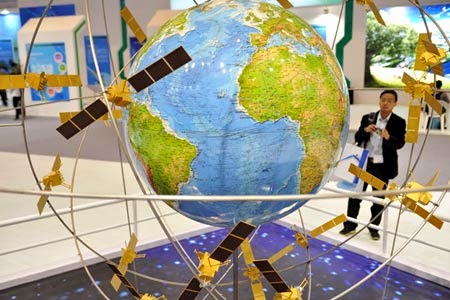
A model of China's Beidou satellite navigation system on display
at the Zhuhai Airshow, Nov. 14, 2012 (Photo/Xinhua).

Russia and China are likely to sign a cooperation pact regarding ground operation stations for Russia's GLONASS satellite and China's Beidou satellite, reports Huanqiu, the website of China's nationalistic tabloid Global Times, citing Sergei Savelyev, deputy head of the Russian space agency Roscosmos.

Savelyev said that Russia expects an agreement with China, which will allow the countries to build three ground operational stations in each other's territory, with the number potentially increasing in the future.

At the St Petersburg International Economic Forum 2014 held in late May, Savelyev also said that Russia is preparing to discuss construction of GLONASS ground operation stations with both China and India and expects to reach an agreement of equal number construction by the end of the year.

The Moscow-based Voice of Russia reported that the number may be more than three, as China initially proposed setting up about a dozen Beidou stations in Russia from the Urals to the Far East, and to host a similar number of GLONASS stations.

A Russian researcher told Huanqui that China and Russia are highly likely to cooperate in a joint satellite navigation system, given that they share a common competitor — the US Global Positioning System (GPS). The wise choice would be for Beijing and Moscow to install each other's devices on the counterparts satellites, the researcher said.

During the 2nd Technoprom International Forum held in Novosibirsk in Russia on June 5-6, Russian deputy prime minister Dmitry Rogozin said that cooperation between Russia and China in the field will not be limited to ground operational stations, but will also include reception devices and related infrastructure. "Our system is more suitable for northern, polar latitudes. The Chinese system is more southern. Their complementary natures would result in a biggest and most powerful competitor to any navigation system," he said.

Meanwhile, Sergei Ivanov, chief of staff of the Presidential Administration of Russia, said that in addition to ground operational stations in China, Russia plans to construct 50 GLONASS ground operation stations with 36 countries. He said that negotiations with Nicaragua, Vietnam, Iran and Indonesia are underway, while agreements with Cuba and Spain have already been reached.

Roscosmos also proposed to construct six ground operational stations in the US, but the plan was turned down due to national security concerns, while the US has already set up 11 GPS stations on Russian soil.

However, Russia announced in May that it would suspend the operation of all 11 GPS stations from June 1 due to poor progress in Russia-US talks over the construction of Russian ground stations in the US. The GPS ground operational stations will be permanently shut on September 1 if the two countries fail to reach a consensus by then, according to Huanqiu.

Wednesday, May 14, 2014

Google self-driving car coming around the corner

Yahoo – AFP, 14 May 2014

Google's Lexus RX 450H Self Driving Car is seen parked on Pennsylvania Ave.
in Washington, DC, on April 23, 2014 (AFP Photo/Mark Wilson)

Mountain View (United States) (AFP) - A white Lexus cruised along a road near the Google campus, braking for pedestrians and scooting over in its lane to give bicyclists ample space.

The car eased into a turn lane, waited for a green light and a break in traffic, then continued on its way in the Silicon Valley city of Mountain View.

It even avoided stopping on train tracks.

But there was nobody holding the wheel. What looked like the work of a conscientious driver was a Google car making all the moves -- with an AFP reporter in the back seat.

Google used machine learning to teach cars how people drive and, from there, to anticipate what motorists in surrounding traffic are likely to do.

Computer-fast reflexes

"Computers have really good reaction times. They don't get distracted, drowsy, fall asleep, and they don't drive drunk," Google self-driving car software team lead Dmitri Dolgov told reporters getting an intimate look at prototypes at the Computer History Museum.

Google's Lexus RX 450H Self Driving Car,
 seen parked on Pennsylvania Ave. in
 Washington, DC, on April 23, 2014
(AFP Photo/Mark Wilson)
"They don't need to stop messing with the radio to see what is happening, or even take time to move a foot from the gas pedal to the brake."

The bustling street crowd paid little heed to the self-driving car, which sported a whirling gadget on top about the size and shape of a large coffee can.

The roof-top device used radar and lasers to track everything around it.

A camera peeking out from the Lexus front grill watched what was ahead.

Data is processed by onboard computers programmed to simulate what a careful driver would do, but at super-human speeds. And, naturally, the Google autonomous car was connected to the Internet.

A "Googler" from the technology titan's test driving team had a laptop computer that showed what the car "saw" -- everything from cyclists and traffic signals to orange cones and painted lines in the street.

Another Googler was in the driver's seat, ready to take over in the unlikely chance a human was needed to make a driving decision.

A red button could be hit to grab control from the computer. A tap of the brake would do the same.

Real driving a drag

Development of the self-driving car began five years ago, part of a special project headed by Google co-founder Sergey Brin.

"If you are in a car commercial, that is driving we enjoy," said project director Chris Urmson.

"If you are commuting to work, that is not fun."

While most people have cars that boast seating for four or more people and that can achieve racing speeds, statistics show that much road time is clocked by solo drivers going closer to 30 miles (48 kilometers) per hour.

Google cars navigate using detailed digital maps showing what streets are supposed to look like, then concentrate processing power on assessing real-world variables such as traffic.

The cars can't drive places where Google hasn't mapped roadways down to implied speed limits, elevations of traffic signals, and curb heights, according to mapping team lead Andrew Chatham.

Google's Lexus RX 450H Self Driving Car, seen parked on Pennsylvania
Ave. in Washington, DC, on April 23, 2014 (AFP Photo/Mark Wilson)

"It tells the car what the world looks like empty, then the job of the software is to figure out what is going on," Chatham said.

Have no fear

Prototype Google cars have driven more than 100,000 miles on public roads, always with someone ready to take the wheel.

There have been two accidents while cars were on auto-pilot. Both times, vehicles were rear-ended while stopped at traffic signals, according to Urmson.

"We are at the point where we are really convinced we have cracked this and can make it work," Urmson said of self-driving cars being trusted on roads.

Urmson sidestepped predicting when Google self-driving cars might hit the market, but said he is determined to make it happen by the time his six-year-old son reaches driving age.

Brin has publicly stated the even more ambitious goal of having the cars ready less than four years from now.

A panel of urban development and transportation specialists that took part in the event billed the self-driving car as a quantum leap in safety that could prevent many of the approximately 33,000 roadway deaths in the US each year.

Instead of owning cars, people could summon them when needed and be chauffeured places while they text, chat on phones, put on make-up or do other distracting tasks some motorists attempt while driving.

"This is not a science project, this is reality," said former General Motors vice president Larry Burns.

"It is something you need to embrace; there is nothing to fear."

Saturday, September 21, 2013

Phone app offers 'verbal autopsies' to improve death records

BBC News, Anne Soy and Anna Lacey,  Health Check, 21 Sep 2013

Verbal interviews with relatives of the deceased are recorded onto
the mobile phone app

Health Check

Two thirds of deaths worldwide go completely unrecorded, making it impossible to know if public health money is being spent in the right places. But could a mobile phone app be the answer?

Birth and death are perhaps the most significant moments of any human life - worth writing down for posterity.

But in many countries around the world, the systems set up to collect vital data about citizens have such low coverage that many deaths slip through the net.

Not knowing who has died, and what they have died of, makes it impossible to build an accurate picture of a nation's health.

Now technology - in the form of a specialist mobile phone app - could make all the difference.

Using a technique known as "verbal autopsy", field workers visit relatives to ask them about the circumstances of a family death.

By collecting the information digitally from currently hard-to-reach places, it has the potential to revolutionise our understanding of global health.

Mobile phone autopsies

In Malawi, any death that occurs outside a medical facility is not recorded.

Dr Carina King, a fellow at University College London, is overseeing the implementation of the mobile phone autopsies in the Malawian district of Mchinji.

"We found everyone surprisingly open, and I think they find the phone quite an interesting thing when we go for interviews," she told the BBC.

Verbal autopsies have been in use for about 20 years but the information was traditionally recorded on a paper questionnaire.

These often lengthy documents were supposed to be analysed by two doctors, who would use the answers to deduce the likely cause of death.

However the sheer scale of the task was often too great, meaning that many of the questionnaires ending up languishing in dusty rooms, completely unread.

"The mobile phone has been very good and means we don't have lots of paper forms," says Dr King.

"We have very quick access to the data and we can analyse it quickly to get the causes of death."

The phone software, known as MIVA, presents a series of questions that a trained field worker uses to find out information from the family.

Each question has a range of possible answers and the software intelligently skips to the next relevant question depending on the response.

Most important of all is that it is designed to quickly compute the most likely cause of death.

The result is stored in the phone and can be sent to a central database either by text message or internet upload.

'Cheap and robust' technology

Dr Jon Bird of City University, London, who was part of the team involved in creating the software, says mobile phones provide a particularly convenient way of collecting data.

"Mobile phones are probably one the most widespread technologies in the world. They're cheap, they're robust and everyone knows how to use one," he told the BBC.

"The everyday nature of mobile phones also makes them really valuable because the people that are being interviewed don't find them intrusive."

In Malawi, mobile phone autopsies are currently being used to record the cause of death in children.

The project is called Mai Mwana, meaning mother and child in the local Chichewa language, and it focuses on children who died before their fifth birthday.

The under-five mortality rate in Malawi is 71 per 1,000 live births according to 2012 figures from the World Bank - compared to just five per 1,000 live births in the UK.

Families are interviewed in the community by trained fieldworkers

Lazaro Cypriano lives in the village of Mzangawa in Mchinji district, central Malawi with his wife Magdalena and their toddler.

The couple lost their first two children.

Their second child died about a year ago, after a series of hospital visits due to fever. It is this death that will be the subject of the verbal autopsy.

'Highly sensitive'

Outside urban areas, one of the main problems for collecting data is finding out when a death has occurred.

To get around this, field reporters from the local community take on the responsibility of alerting the MaiMwana team of people who have died in their area.

This is how Lazaro's family was identified, and the visit now affords him his first opportunity to narrate what happened to his son and have that information recorded.

The interviewer asks the couple standard questions and matches their answers to the choices provided in the application's template.

It's a highly sensitive and skilled job - and one which field interviewer Nicholas Mbwana can see is made easier by using a mobile phone.

"We go to the households, ask about the causes of death - what really happened - and we also record the GPS in order to trace the household in future," he told the BBC.

Dr King says the system is key to the success of the project.

"GPS gives us the location of every household in the district so we can actually plot out on a map where people are dying of what, which means that you could design more sophisticated programs for targeting specific interventions."

The bigger picture

Mobile phone autopsies are being used on a limited scale at present. But the long term aim is to roll out the technique much more widely.

"The beauty of the system is that it's standardised and can be translated into any language you want," says Dr Bird.

"It's important when you're collecting data on a large scale that everyone is answering the same question, so that you know that the results are directly comparable from town to town and country to country."

Interviewees' answers are inputted directly into the mobile phone app

The World Health Organization (WHO) is already supporting the initiative and is working with institutions from the UK to Sweden to develop the technology further.

The data is currently being collected in a range of databases that can be accessed by researchers interested in public health.

As the project grows, researchers from the University of Umea in Sweden will co-ordinate the growing number of translations and the distribution of the technology around the world.

The government in Malawi is already keen to see the results of the project.

"It is important for us as a ministry to know what is killing Malawians out there so that we can plan ahead and put appropriate interventions in place to prevent that - and also to put out health messages," says Dr Charles Mwansambo, Malawi's Health Secretary.

The Ministry of Health has so far only been using information collected from medical facilities, which the health secretary concedes is biased data.

"We need comprehensive data from the hospitals and the community to plan well. We find ourselves planning for the small community that comes to hospital, not realising there is a bigger community out there that we need to budget for," he adds.

Significant inroads

Dr Mwansambo also acknowledges that a cultural practice of burying health documents with the dead makes it difficult to collect important information about deaths.

"When somebody dies people want to forget everything about them - those memories that will remind them of their loved ones. So unfortunately they bury the health passport along with their clothes and other possessions and we lose vital information in the process," he explains.

The health passports are documents issued to parents, which record the birth weight of the baby and its gain over time, as well as which immunizations were administered and when.

An elder at Mzangawa village, Kangkwamba Piri, is already talking to members of his community to drop that cultural practice.

"We've been doing this for a long time but it is wrong. What needs to be done is not to bury the documents and that's what we're encouraging people to do," he says.

For now, it is likely that millions of deaths will still go unnoticed by official figures. But verbal autopsies recorded on mobile phones are making small but significant inroads into solving the problem.

And for and his wife Magdalena, the chance to give information about what killed their child to an official is important.

Magdalena says: "What I have learnt from this interview will help me take care of my third baby so he can be healthy and live long."

Related Article: