The Internet - The first Worldwide Tool of Unification ("The End of History")

" ... Now I give you something that few think about: What do you think the Internet is all about, historically? Citizens of all the countries on Earth can talk to one another without electronic borders. The young people of those nations can all see each other, talk to each other, and express opinions. No matter what the country does to suppress it, they're doing it anyway. They are putting together a network of consciousness, of oneness, a multicultural consciousness. It's here to stay. It's part of the new energy. The young people know it and are leading the way.... "

" ... I gave you a prophecy more than 10 years ago. I told you there would come a day when everyone could talk to everyone and, therefore, there could be no conspiracy. For conspiracy depends on separation and secrecy - something hiding in the dark that only a few know about. Seen the news lately? What is happening? Could it be that there is a new paradigm happening that seems to go against history?... " Read More …. "The End of History"- Nov 20, 2010 (Kryon channelled by Lee Carroll)

"Recalibration of Free Choice"– Mar 3, 2012 (Kryon Channelling by Lee Carroll) - (Subjects: (Old) Souls, Midpoint on 21-12-2012, Shift of Human Consciousness, Black & White vs. Color, 1 - Spirituality (Religions) shifting, Loose a Pope “soon”, 2 - Humans will change react to drama, 3 - Civilizations/Population on Earth, 4 - Alternate energy sources (Geothermal, Tidal (Paddle wheels), Wind), 5 – Financials Institutes/concepts will change (Integrity – Ethical) , 6 - News/Media/TV to change, 7 – Big Pharmaceutical company will collapse “soon”, (Keep people sick), (Integrity – Ethical) 8 – Wars will be over on Earth, Global Unity, … etc.) - (Text version)

“…5 - Integrity That May Surprise…

Have you seen innovation and invention in the past decade that required thinking out of the box of an old reality? Indeed, you have. I can't tell you what's coming, because you haven't thought of it yet! But the potentials of it are looming large. Let me give you an example, Let us say that 20 years ago, you predicted that there would be something called the Internet on a device you don't really have yet using technology that you can't imagine. You will have full libraries, buildings filled with books, in your hand - a worldwide encyclopedia of everything knowable, with the ability to look it up instantly! Not only that, but that look-up service isn't going to cost a penny! You can call friends and see them on a video screen, and it won't cost a penny! No matter how long you use this service and to what depth you use it, the service itself will be free.

Now, anyone listening to you back then would perhaps have said, "Even if we can believe the technological part, which we think is impossible, everything costs something. There has to be a charge for it! Otherwise, how would they stay in business?" The answer is this: With new invention comes new paradigms of business. You don't know what you don't know, so don't decide in advance what you think is coming based on an old energy world. ..."
(Subjects: Who/What is Kryon ?, Egypt Uprising, Iran/Persia Uprising, Peace in Middle East without Israel actively involved, Muhammad, "Conceptual" Youth Revolution, "Conceptual" Managed Business, Internet, Social Media, News Media, Google, Bankers, Global Unity,..... etc.)


German anti-hate speech group counters Facebook trolls

German anti-hate speech group counters Facebook trolls
Logo No Hate Speech Movement

Bundestag passes law to fine social media companies for not deleting hate speech

Honouring computing’s 1843 visionary, Lady Ada Lovelace. (Design of doodle by Kevin Laughlin)
Showing posts with label ireland. Show all posts

Thursday, December 31, 2020

Facebook to close Irish units at center of tax dispute

Rfi.fr – AFP, 30 December 2020 

Facebook said its Irish subsidiary at the heart of a dispute on shifting profits
 to avoid taxes has been closed, with the assets brought back to the California
giant DENIS CHARLET AFP/File

Washington (AFP) - Facebook confirmed Wednesday it was closing its Irish subsidiaries at the center of a dispute on profit shifting to avoid taxes in the United States. 

The California tech giant acknowledged the winding down of Facebook Ireland Holdings Unlimited Company amid a dispute with US tax authorities, which claimed the company owed billions in taxes by improperly shifting profits offshore. 

A Facebook spokesperson said the move was "part of a change that best aligns with our operating structure" and that the holdings of the three subsidiaries were "distributed to its US parent company." 

The closing was previously reported by the Times of London and other media. 

Facebook has disputed the claims from US tax authorities seeking some $9 billion for allegedly undervaluing intellectual property assets used by the social network. 

But it noted that these assets were repatriated in July in a move which "best aligns corporate structure with where we expect to have most of our activities and people." 

Facebook says it has paid more than $11 billion globally in income tax over the past three years and that its effective tax rate over the last five years exceeds 20 percent. 

The news comes amid stalled negotiations on a new global tax treaty which would allocate profits of multinational firms including tech giants and efforts by some countries to unilaterally impose digital taxes based on revenues. 

In November, some 75 major tech players, including Google and Facebook, backed a French initiative committing them to making a "fair tax contribution" in countries where they operate.

Related Article:

Google to stop using ‘double Irish, Dutch sandwich’ tax dodge: Reuters

Friday, January 3, 2020

Google to stop using ‘double Irish, Dutch sandwich’ tax dodge: Reuters

DutchNews, January 2, 2020 

Photo: Depositphotos.com

Google parent Alphabet is to stop using an intellectual property licensing loophole, known as the ‘Double Irish, Dutch sandwich’, which allowed it to cut its global tax bill, Reuters reports. 

The strategy involves companies moving money from an Irish subsidiary to a Dutch holding company and then back to an Irish holding company located in Bermuda with licensing rights to Google intellectual property. 

Because Bermuda has no corporate income tax it was lucrative for Google to report income there, effectively delaying tax payment on international earnings to the US for years while paying a lower tax rate in Europe. 

After pressure from the EU and the US Ireland closed the loopholes in 2014 and companies were given until 2020 to comply with new tax regulations. 

Dutch filings at the Chamber of Commerce and seen by Reuters showed that in 2018 Google moved €21.8bn through its Dutch holding company to Bermuda, up from €19.9bn in 2017. 

Reuters said the filing did not give a definite end date but that Google management expected the termination to take place ‘as of 31 December 2019 or during 2020′. 

The scheme was in place for over a decade and allowed the tech giant to cut its tax bill by hundreds of billions of euros, the Guardian estimates. 

The Netherlands does not currently tax royalties, but is planning to change this as part of a package of measures to crack down on tax evasion in 2021. 

Some 10,000 shell, or letter-box, companies are based in the Netherlands and are primarily used to shift corporate earnings and obscure ownership. Google has used its Dutch affiliate to move money since 2004.

Friday, August 9, 2019

Twitter reveals unauthorized data use

France24 – AFP, 7 August 2019

Twitter said the error had been corrected and that it was "taking steps to make
sure we don?t make a mistake like this again" AFP/File

Paris (AFP) - The social network Twitter said overnight that user's personal data had been used for advertising purposes, without their consent and despite dedicated settings to counteract such events.

A Twitter statement said the fault was corrected Monday and that an investigation was being conducted to determine how many people had been affected, while advising users to verify their data sharing settings.

The situation involved two cases, the first one arising if users clicked or viewed an advertisement for a mobile application and then interacted with it since May 2018.

"In that case, we may have shared certain data (e.g., country code, if you engaged with the ad and when, information about the ad, etc) with trusted measurement and advertising partners, even if you didn't give us permission to do so," the statement said.

The second case involved Twitter showing people ads "based on inferences we made about the devices you use, even if you did not give us permission to do so," it added.

In that case, data was not used outside the company and did not contain personal information such as passwords or e-mail accounts, according to Twitter.

Twitter apologised for not respecting users' choices, and insisted that it was "taking steps to make sure we don?t make a mistake like this again."

"What is there for you to do? Aside from checking your settings, we don't believe there is anything for you to do," the statement said.

It provided a link to a form that allows users to contact its office of data protection for more information.

The problems arose after Europe's General Data Protection Regulation (GDPR) took effect in May 2018.

The GDPR binds social media platforms and websites to ensuring they have user's explicit consent to collect personal data for advertising purposes or on behalf of third-party enterprises.

It also obliges companies that have been a victim of personal data loss to alert competent authorities in the country where their European headquarters are located, in this case Ireland, within 48 hours of their discovery, and the people affected as soon as possible.

Friday, January 25, 2019

'The new oil': Dublin strikes it rich as Europe's data hub

Yahoo – AFP, Joseph STENSON, January 24, 2019
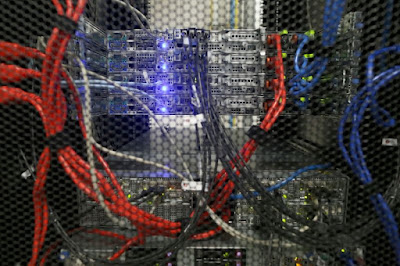
The centres provide 24/7/365 access to the massive data, processing power and
storage that digital services around Europe require (AFP Photo/PAUL FAITH)

Dublin (AFP) - A new industrial revolution is under way on the outskirts of Dublin.

Fortunes are being made in clusters of anonymous warehouses housing vast data centres.

"Data is the new oil, definitely," said Brian Roe, commercial director of Servecentric, a data centre company.

Roe is a new breed of prospector, presiding over one node in a network of 48 data centres in Ireland.

Put simply, these powerhouse developments provide 24/7/365 access to the massive data, processing power and storage that digital services around Europe require.

"People are saying, 'Well everything is going to come from the cloud'," Roe said.

"Well where's the cloud? The cloud is data centres."
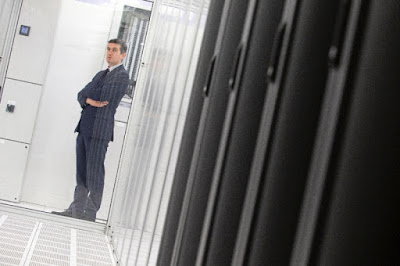
"People are saying, 'Well everything is going to come from the cloud'," Roe said.
"Well where's the cloud? The cloud is data centres" (AFP Photo/PAUL FAITH)

A fortune in the making

According to industry lobby group Host in Ireland, the country has become the unlikely engine room for everything from video streaming to phone apps and social media.

Government incentives, a skilled workforce and high connectivity to Europe and America are helping attract data centre construction investment which is expected to reach nine billion euros ($10 billion) by 2021.

The sector employs 5,700 people in full-time equivalent roles including 1,800 as data centre operators, according to a report produced for Ireland's investment agency.

Nestled in an industrial estate next to a motorway, Servecentric is a "co-location" site shared by multiple businesses, dwarfed by the exclusive "hyperscale" establishments of Google, Amazon and Facebook.

In the lobby, visitors are asked to present ID to a security guard. Fingerprint scanners abound and 160 CCTV cameras record footage stored for three months.

One client requires six levels of security, including airport-style checks and private guards in their portion of the centre.

Nestled in an industrial estate next to a motorway outside Dublin, Servecentric is a
"co-location" site shared by multiple businesses, dwarfed by the exclusive "hyperscale"
establishments of Google, Amazon and Facebook (AFP Photo/PAUL FAITH)

Roe, touring the facility in a crisp suit, declines to say who, but says they are a "household name".

The secrecy is in service of the library-like rows of cabinets decked with blinking servers plugged with neatly bundled wires. All are locked away like safe deposit boxes.

The space whirrs with the constant air conditioning required to prevent overheating -- evidence of voracious power consumption which, for some, is causing concern.

State-owned power provider Eirgrid says data centres "can require the same amount of energy as a large town" and could account for 31 percent of Ireland's total energy demand by 2027.

In May, Apple pulled out of a 875 million euro ($1 billion) data centre development on Ireland's west coast after objectors claimed it could eventually increase the demand on the grid by up to eight percent.

With Ireland set to miss its 2020 and 2030 climate change targets, according to the country's environmental watchdog, industry is keen to play down energy concerns.

Facebook has made a PR push at its new 200 million euro ($230 million) centre in Clonee near Dublin, assuring locals it is 100 percent powered by renewables.

Secrecy and security

There are also concerns that the opacity and transnational nature of the data business could end up with Ireland harbouring or supporting unethical or illegal practices of the type seen in last year's Cambridge Analytica scandal.

Amazon Web Services (AWS) -- which provides cloud services for hire -- is a particular concern for Paul O' Neill, a researcher at Dublin City University.
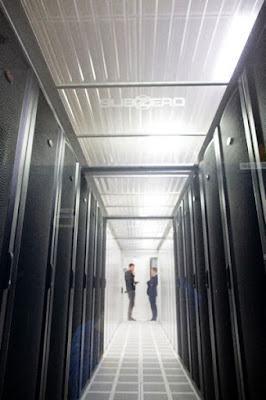
Library-like rows of cabinets are decked with blinking 
servers plugged with neatly bundled wires. All are l ocked 
away like safe deposit boxes (AFP Photo/PAUL FAITH)

"The ethical implications of hosting AWS data centres in Ireland are potentially vast," he said.

AWS, which plans to expand its Dublin operations, sells controversial facial recognition technology to US police.

"These corporations are or have been involved in many of the dominant controversies and debates of our contemporary networked era including privacy, data breaches and surveillance," O'Neill said.

Data centres do have at least some local support.

When Apple pulled out of plans for the west coast Athenry development -- predicted to bring 150 jobs to the remote area -- campaign group "Athenry for Apple" mourned it as "an absolute hammer blow to the locality".

But plans for a million square foot (93,000 square metre) data centre, currently at the early stages in the nearby west coast town of Ennis, have sparked local concerns.

"Data centres use massive amounts of energy, which is all well and good if the energy is sustainable and secure," said Theresa O'Donohoe, who represents the community in planning matters.

"Surely if a data centre is the technology of the future we should be powering it sustainably, as is required to address climate change?"