The Internet - The first Worldwide Tool of Unification ("The End of History")

" ... Now I give you something that few think about: What do you think the Internet is all about, historically? Citizens of all the countries on Earth can talk to one another without electronic borders. The young people of those nations can all see each other, talk to each other, and express opinions. No matter what the country does to suppress it, they're doing it anyway. They are putting together a network of consciousness, of oneness, a multicultural consciousness. It's here to stay. It's part of the new energy. The young people know it and are leading the way.... "

" ... I gave you a prophecy more than 10 years ago. I told you there would come a day when everyone could talk to everyone and, therefore, there could be no conspiracy. For conspiracy depends on separation and secrecy - something hiding in the dark that only a few know about. Seen the news lately? What is happening? Could it be that there is a new paradigm happening that seems to go against history?... " Read More …. "The End of History"- Nov 20, 2010 (Kryon channelled by Lee Carroll)

"Recalibration of Free Choice"– Mar 3, 2012 (Kryon Channelling by Lee Carroll) - (Subjects: (Old) Souls, Midpoint on 21-12-2012, Shift of Human Consciousness, Black & White vs. Color, 1 - Spirituality (Religions) shifting, Loose a Pope “soon”, 2 - Humans will change react to drama, 3 - Civilizations/Population on Earth, 4 - Alternate energy sources (Geothermal, Tidal (Paddle wheels), Wind), 5 – Financials Institutes/concepts will change (Integrity – Ethical) , 6 - News/Media/TV to change, 7 – Big Pharmaceutical company will collapse “soon”, (Keep people sick), (Integrity – Ethical) 8 – Wars will be over on Earth, Global Unity, … etc.) - (Text version)

“…5 - Integrity That May Surprise…

Have you seen innovation and invention in the past decade that required thinking out of the box of an old reality? Indeed, you have. I can't tell you what's coming, because you haven't thought of it yet! But the potentials of it are looming large. Let me give you an example, Let us say that 20 years ago, you predicted that there would be something called the Internet on a device you don't really have yet using technology that you can't imagine. You will have full libraries, buildings filled with books, in your hand - a worldwide encyclopedia of everything knowable, with the ability to look it up instantly! Not only that, but that look-up service isn't going to cost a penny! You can call friends and see them on a video screen, and it won't cost a penny! No matter how long you use this service and to what depth you use it, the service itself will be free.

Now, anyone listening to you back then would perhaps have said, "Even if we can believe the technological part, which we think is impossible, everything costs something. There has to be a charge for it! Otherwise, how would they stay in business?" The answer is this: With new invention comes new paradigms of business. You don't know what you don't know, so don't decide in advance what you think is coming based on an old energy world. ..."
(Subjects: Who/What is Kryon ?, Egypt Uprising, Iran/Persia Uprising, Peace in Middle East without Israel actively involved, Muhammad, "Conceptual" Youth Revolution, "Conceptual" Managed Business, Internet, Social Media, News Media, Google, Bankers, Global Unity,..... etc.)


German anti-hate speech group counters Facebook trolls

German anti-hate speech group counters Facebook trolls
Logo No Hate Speech Movement

Bundestag passes law to fine social media companies for not deleting hate speech

Honouring computing’s 1843 visionary, Lady Ada Lovelace. (Design of doodle by Kevin Laughlin)
Showing posts with label South America. Show all posts

Sunday, September 23, 2018

Facebook dating service rolling out in Colombia

Yahoo – AFP, 22 September 2018

Facebook is test-driving a dating service in Colombia

Facebook said Friday a dating service it teased early this year is being rolled out in Colombia.

The social media giant chose the Latin American country as its test lab because Colombians are particularly avid fans of using social networks and websites to find partners.

The new feature, rolled out in Colombia this week, allows users to create a separate "dating" profile not visible to their network of friends, with potential matches recommended based on preferences and common interests.

The service is programmed not to link up people who are already connected as family or friends, and users of Facebook Dating will also be able to block people if they wish.

A basic chat service will be available, and the site will bar strangers from sending photos, videos or links.

Some 21 million people log in to Facebook every day in Colombia, a country of 50 million people, according to the company.

"We view this as an incredible opportunity to continue helping people build relationships in meaningful ways on Facebook," said Facebook Dating product manager Nathan Sharp.

Facebook's chief Mark Zuckerberg in May announced plans for the new dating feature at the world's leading online social network -- while vowing to make privacy protection its top priority in the wake of the Cambridge Analytica scandal.

Zuckerberg was emphatic that the focus would be on helping people find partners, not flings.

"This is going to be for building real, long-term relationships, not just hookups," Zuckerberg said in presenting the new feature.

He said the dating offer was built with privacy and safety in mind.

Facebook faced intense global scrutiny over the mass harvesting of personal data by Cambridge Analytica, a British political consultancy that worked for Donald Trump's 2016 election campaign.

The company has admitted up to 87 million users may have had their data hijacked in the scandal.

Related Article:


Saturday, August 30, 2014

Ecuador gives details of new digital currency

BBC News, 29 August 2014

The central bank says the electronic currency will make life easier for consumers

The Ecuadorean government has released more details of its plans to create what it calls the world's first digital currency issued by a central bank.

Central bank officials say the electronic money, as yet unnamed, will start circulating in December.

The new money will be used alongside the existing currency in Ecuador, the US dollar.

President Rafael Correa has said the digital currency will help those who cannot afford traditional banking.

Central bank officials say the electronic money will be used to pay government bureaucrats in a "hygienic manner".

The electronic currency is also designed to help poorer Ecuadoreans make and receive payments using mobile phone technology.

Such mobile payment schemes have become very popular in African countries where they are privately run.

Ecuador introduced the US dollar as its currency after a crippling bank crisis in 2000.

President Rafael Correa has denied any plans to replace the US dollar

Since then, the government has tripled social spending and the state is currently billions in debt, mostly to China which buys most of Ecuador's oil.

Analysts say the introduction of the electronic currency could be used to increase the money supply and devalue US dollar holdings - a first step towards abandoning the US dollar.

President Correa has denied this is the case.

Exchange rate

"It will be interesting to see who controls the exchange rate," said Jeremy Booney - a product manager for Coindesk - a website for digital currency news.

"So when an Ecuadorean exchanges the digital currency for US dollars, is it going to be the government who sets the rate, or is it down to supply and demand?

"And the government could decide to put the digital currency up if it wants."

There are also challenges in persuading Ecuadoreans to use a digital currency, Mr Booney said.

"Bitcoin (a global digital currency) has faced huge challenges to get people around the world to use it, and that is a worldwide movement with thousands of developers working on it."

The new currency was approved by Ecuador's National Assembly last month. At the same time, stateless digital currencies like Bitcoin were banned.

Monday, June 30, 2014

Google executives visit Cuba to promote free Internet

Yahoo – AFP, 30 June 2014

AFP

Google (Xetra: GGQ1.DE - news) executive chairman Eric Schmidt visited Cuba this week along with three other top executives to promote "a free Internet," Cuban independent online newspaper "14yMedio" reported Sunday.

The four executives "met with officials," spoke "with youth at polytechnical schools" and, on Saturday, visited the University of Computer Sciences in western Havana, wrote the newspaper, run by dissident blogger Yoani Sanchez.

The two-day visit to the Americas' only communist-run country also included Jared Cohen, Brett Perlmutter and Dan Keyserling.

It was the first such visit by Google executives to "promote the virtues of a free and open Internet," said the new site, which was also contacted by the visiting team.

The visit by Google, which has been accused by Cuba of "scandalously" blocking some of its services on the island, was not reported in any official media.

The Internet giant has justified the services blocked under the full US economic embargo that has been in place since 1962.

In her blog GeneracionY, Sanchez described her meeting Friday with the Google team as "an online workshop."

"We didn't ask him any questions and we didn't want any answers, we just told him who we are and what we are trying to do."

US-based Schmidt confirmed the trip on a Google+ posting Sunday, saying US sanctions on Cuba defied reason.

"Walking around (Havana), it's possible to imagine a new Cuba, perhaps a leader of Latin America education, culture, and business," he wrote.

"Cuba will have to open its political and business economy, and the US will have to overcome our history and open the embargo. Both countries have to do something that is hard to do politically, but it will be worth it," Schmidt argued.?

An underwater cable connecting Cuba to Venezuela opened possibilities to upgrade Internet service starting in 2013.

However, Cuban authorities said financial limitations stopped them from increasing access, and continued with their policy of prioritizing use for universities, research institutes and state entities.

The only Cuban residents who can connect to the Internet from their homes are doctors, journalists and other professionals authorized by the government.

Havana accuses Sanchez, along with other Cuban dissidents, of being a US-paid "mercenary."

Thursday, June 26, 2014

Russia, China to combine efforts in satellite battle with US

Want China Times, Staff Reporter 2014-06-26

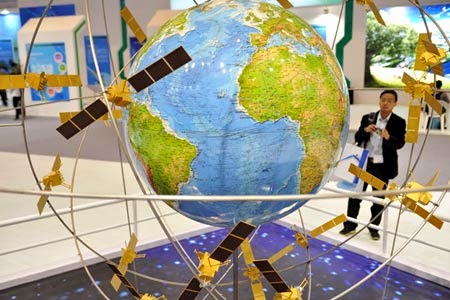
A model of China's Beidou satellite navigation system on display
at the Zhuhai Airshow, Nov. 14, 2012 (Photo/Xinhua).

Russia and China are likely to sign a cooperation pact regarding ground operation stations for Russia's GLONASS satellite and China's Beidou satellite, reports Huanqiu, the website of China's nationalistic tabloid Global Times, citing Sergei Savelyev, deputy head of the Russian space agency Roscosmos.

Savelyev said that Russia expects an agreement with China, which will allow the countries to build three ground operational stations in each other's territory, with the number potentially increasing in the future.

At the St Petersburg International Economic Forum 2014 held in late May, Savelyev also said that Russia is preparing to discuss construction of GLONASS ground operation stations with both China and India and expects to reach an agreement of equal number construction by the end of the year.

The Moscow-based Voice of Russia reported that the number may be more than three, as China initially proposed setting up about a dozen Beidou stations in Russia from the Urals to the Far East, and to host a similar number of GLONASS stations.

A Russian researcher told Huanqui that China and Russia are highly likely to cooperate in a joint satellite navigation system, given that they share a common competitor — the US Global Positioning System (GPS). The wise choice would be for Beijing and Moscow to install each other's devices on the counterparts satellites, the researcher said.

During the 2nd Technoprom International Forum held in Novosibirsk in Russia on June 5-6, Russian deputy prime minister Dmitry Rogozin said that cooperation between Russia and China in the field will not be limited to ground operational stations, but will also include reception devices and related infrastructure. "Our system is more suitable for northern, polar latitudes. The Chinese system is more southern. Their complementary natures would result in a biggest and most powerful competitor to any navigation system," he said.

Meanwhile, Sergei Ivanov, chief of staff of the Presidential Administration of Russia, said that in addition to ground operational stations in China, Russia plans to construct 50 GLONASS ground operation stations with 36 countries. He said that negotiations with Nicaragua, Vietnam, Iran and Indonesia are underway, while agreements with Cuba and Spain have already been reached.

Roscosmos also proposed to construct six ground operational stations in the US, but the plan was turned down due to national security concerns, while the US has already set up 11 GPS stations on Russian soil.

However, Russia announced in May that it would suspend the operation of all 11 GPS stations from June 1 due to poor progress in Russia-US talks over the construction of Russian ground stations in the US. The GPS ground operational stations will be permanently shut on September 1 if the two countries fail to reach a consensus by then, according to Huanqiu.

Thursday, April 24, 2014

Brazil passes online privacy law as Web governance conference starts in Sao Paulo

Deutsche Welle, 23 April 2014

Brazilian President Dilma Rousseff has ratified a bill guaranteeing Internet privacy and access to the Web. It comes as Sao Paulo hosts a global conference on Internet governance.


The legislation, which was passed by parliament late on Tuesday, puts limits on the metadata that can be collated from Internet users in Brazil. It also makes Internet service providers not liable for content published by their users and requires them to comply with court orders to remove offensive material.

Rousseff, who was in Sao Paulo for the opening of the NetMundial global conference on Internet governance, has been at the forefront of efforts to formally recognize Internet freedom and privacy.

Rousseff has been pushing for
measures on Internet governance
Last year, when it was revealed that she had been under surveillance by the National Security Agency (NSA), Rousseff cancelled a state visit to the US and started to champion Internet freedom and privacy.

Speaking at the opening of NetMundial, she said that "the Internet we want will only be possible in a scenario of respect for human rights, in particular the right to privacy and freedom of expression."

Despite her differences with the US, Rousseff praised Washington for its decision to hand over the management of ICANN and IANA, which manage the Internet's global domain name system, next September.

"I salute the US government's recently announced plan to replace its links to IANA and ICANN with a global management of those institutions," she said on Wednesday.

During the two-day conference, government officials, industry executives and academics from around the world are expected to agree on a set of principles to enhance online privacy that does not overly restrict the Internet's self-regulated nature.

They will also debate how to govern the Internet after the US hands over the reins at ICANN. The meeting's resolutions are non-binding, but Brazil hopes they can serve as the foundation for further discussions on Internet governance.

The main challenge is to find common ground between different governments and corporate Internet giants like Facebook and Google, who are opposed to more regulation.

ng/rc (AP, Reuters)

Tuesday, February 25, 2014

Rousseff backs EU-Brazil cable project

Deutsche Welle, 24 February 2014

Brazil and the EU plan to establish a communications network complete with undersea cable to circumvent the US National Security Agency. It's the outcome of a visit to Brussels by Brazilian President Dilma Rousseff.


Brazil and the EU welcomed on Monday a German proposal to create a European network to avert US surveillance. At a summit in Brussels, Rousseff said the joint project would "guarantee the neutrality" of the Internet.

Brazilian telecoms provider Telebras and Spain's IslaLink plan major shares in the cable project priced at $185 million (135 million euros). European and Brazilian pension funds would put up the remainder.

The cable would span the Atlantic Ocean, from the Portuguese capital Lisbon to Fortaleza in northeastern Brazil.

Last year, it emerged that the National Security Agency (NSA) had spied on Rousseff's email and phone communications. US President Barack Obama apologized to Merkel for surveillance of her mobile phone.

"We have to respect privacy, human rights and the sovereignty of nations. We don't want businesses to be spied upon," Rouseff told a news conference in the presence of top EU officials.

"We will continue to enhance data protection and global privacy standards," said President Herman Van Rompuy.

Brussels has since scrutinized EU-Us agreements on data transfers, demanding increased guarantees for the protection of data of citizens in the EU.

The EU is a major trading partner with Brazil, receiving more than 20 percent of Brazil's exports and accounting for a similar share of its imports.

Talks on a long-envisaged free-trade deal were however delayed at the summit, officials said.

ipj/dr (dpa, AFP, Reuters)

Access to one of the building's floors requires US
government clearance

Related Articles:


Monday, October 14, 2013

Brazil announces secure email to counter US spying

Google – AFP, 14 October 2013

Brazilian President Dilma Rousseff in Brasilia on October 8, 2013 (AFP/File,
 Evaristo Sa)

Brasilia — Brazilian President Dilma Rousseff announced Sunday that her government was creating a secure email system to try and shield official communications from spying by the United States and other countries.

"We need more security on our messages to prevent possible espionage," Rousseff said on Twitter, ordering the Federal Data Processing Service, or SERPRO, to implement a safe email system throughout the federal government.

The agency, which falls under Brazil's Finance Ministry, develops secure systems for online tax returns and also creates new passports.

The move came after Rousseff publicly condemned spying against Brazilian government agencies attributed to the United States and Canada.

"This is the first step toward extending the privacy and inviolability of official posts," Rousseff said.

After bringing her complaints against US intelligence agencies to the United Nations General Assembly last month and canceling a state visit to Washington, Rousseff announced that the country will host an international conference on Internet governance in April.

In recent months, Brazilian media outlets have published documents showing that the US National Security Agency's spied on Rousseff's official communications, her close associates and state-controlled oil giant Petrobras.

The information was revealed by Edward Snowden, a 30-year-old former NSA contractor who has sought refuge in Russia and is wanted by the United States after revealing details of the agency's massive snooping activities.

Related Articles:


Wednesday, August 21, 2013

Facebook Unveils Global Internet Access Initiative

Jakarta Globe – AFP, August 21, 2013

A man is silhouetted against a video screen with an Facebook logo as he
 poses with a laptop in this photo illustration taken in the central Bosnian
town of Zenica on Aug. 14, 2013. (Reuters Photo/Dado Ruvic)

New York City. Facebook and other technology giants launched an initiative on Wednesday designed to give the whole world access to the Internet.

The project is entitled Internet.org and its goal is to extend Internet access to five billion people by cutting the cost of smart phone-based Internet services in developing countries.

“Everything Facebook has done has been about giving all people around the world the power to connect,” Facebook founder Mark Zuckerberg said.

“There are huge barriers in developing countries to connecting and joining the knowledge economy,” he said, adding that the project aimed to make it easier and cheaper to connecting to the web.

The other partners in the project are Nokia, Ericsson, Samsung, Qualcomm, MediaTek and Opera, while Twitter and LinkedIn are also due to sign up.

Today some 2.7 billion people, just over a third of the world’s population, have access to the Internet, and the number of new users is growing only slowly each year, a statement said.

“The goal of Internet.org is to make Internet access available to the two-thirds of the world who are not yet connected, and to bring the same opportunities to everyone that the connected third of the world has today,” the statement said.

The seven founding partners are going to develop joint projects, share knowledge and mobilize governments and industry to bring the world online.

Specifically, they want to simplify mobile apps to make them more efficient and improve telephone components and networks so they perform better while consuming less energy.

They also want to develop lower-cost, higher-quality smartphones and partnerships to more broadly deploy Internet access in underserved communities.

Zuckerberg insisted in an interview with CNN that the project was not simply aimed at generating more customers.

“If we were just focused on making money, the first billion people we’ve connected have way more money than the rest of the next six billion combined. It’s not fair but it’s the way that it is,” he said.

The partnership emulates one launched by Facebook in 2011 called Open Compute Project, which also aims to improve the materials used in call centers and make them less energy-hungry.

That project was originally met with scepticism but has gradually won over the major players in the computer industry.

The new thrust comes at a key time for tech groups. Mature markets are saturated and have little potential for significant growth, while poor regions like Africa, Latin America and some parts of Asia are pools of potential new customers.

Agence France-Presse

Wednesday, August 14, 2013

Samsung Brazil violated labour laws, prosecutors allege

BBC News, 13 August 2013

Related Stories
The Samsung plant in Brazil produces
 electronics for the whole of Latin America
Public prosecutors in Brazil have begun legal action against South Korean electronics giant Samsung, alleging that it has been violating labour laws at its factory in the Amazon region.

Prosecutors accuse the company of making its employees work long, tiring shifts without sufficient breaks.

The prosecutors' office in the city of Manaus said one worker reported packing nearly 3,000 phones a day.

Samsung said it would take action "as soon as they are officially notified".

In a statement, the company said it would analyse the process and fully co-operate with the Brazilian authorities.

"We are committed to offering our collaborators around the world a work environment that ensures the highest standards when it comes to safety, health and well-being," the statement said.

Health accusations

The plant, located at the Manaus Free Trade zone, employs some 6,000 people.

A worker at the Amazonas state factory has only 32 seconds to fully assemble a mobile phone and 65 seconds to put together a television set, prosecutors allege.

In evidence given to prosecutors, employees say shifts can last 15 hours and some say they suffer from back ache and cramps as they are forced to stand for up to 10 hours a day.

The prosecutors' office is claiming more than 250m reais ($108m; £70m) in damages from the company for serious violations of labour legislation.

The legal suit was filed on Friday, but has only now been made public.

Wednesday, May 29, 2013

Huge US fraud probe targets digital currency

Google – AFP, Sebastian Smith (AFP), 28 May 2013

Customers would go to Liberty Reserve's website to buy online currency
used in transactions with other LR users (DPA/AFP/File, Marius Becker)

NEW YORK — The United States on Tuesday unveiled what it called the world's "largest" money laundering probe against the digital currency operator Liberty Reserve.

The Costa Rica-based entity, which handled huge amounts of money outside the control of national governments, is charged with running a "$6 billion money laundering scheme and operating an unlicensed money transmitting business," the US Attorney's office for New York said.

Prosecutors said Liberty Reserve processed at least 55 million illegal transactions for at least one million users "and facilitated global criminal conduct."

The probe involved law enforcement in 17 countries and "is believed to be the largest money laundering prosecution in history," the prosecutor's office said.

Liberty Reserve's principals were arrested on Friday in a round-up launched simultaneously in Costa Rica, Spain and in New York, sealing the fate of a company that had been one of the most successful in the wildly popular but increasingly scrutinized world of unofficial banking and virtual currencies.

The unsealed indictment accuses founder Arthur Budovsky -- a former US citizen who took on Costa Rican nationality -- and his partners of creating a firm that masqueraded as a convenient and legitimate money transfer system.

In reality, the organization turned itself into the "financial hub of the cyber-crime world," the indictment said.

Customers would go to Liberty Reserve's now shut-down website to buy the online currency, known as LRs, that could then be used in transactions with other LR users.

The system was not registered with the US authorities and unlike some other non-state currency systems did not require proof of identity for users.

Adding another important layer of anonymity, Liberty required customers to buy or sell their LRs via third party exchangers, meaning that there was no direct link between a customer's traditional bank account and Liberty's system.

An extra service would allow a user to hide "his own Liberty Reserve account number when transferring funds, effectively making the transfer completely untraceable, even within Liberty Reserve's already opaque system."

The system, the indictment says, was tailor-made for criminal transactions and money-laundering, facilitating "a broad range of online criminal activity, including credit card fraud, identity theft, investment fraud, computer hacking, child pornography, and narcotics trafficking."

"The scope of the defendants' unlawful conduct is staggering," the indictment said.

"With more than 200,000 users in the United States, Liberty Reserve processed more than 12 million financial transactions annually, with a combined value of more than $1.4 billion."

Budovsky and his partners started Liberty Reserve after an earlier similar venture, Gold Age Inc, which traded the E-Gold digital currency, was shut down by US authorities.

It was then that Budovsky emigrated to Costa Rica, later renouncing his US citizenship.

Virtual currencies have grown exponentially, but face pressure on numerous fronts. The popular Bitcoin system has come under scrutiny by financial authorities and seen growing trading volatility.


Liberty Reserve used 45 bank accounts around the world
to transfer money

Related Article:


Friday, February 1, 2013

Behind the scenes of Latin America's internet 'brain'

BBC News, Thomas Sparrow, Mundo, Miami, 31 January 2013

Access to one of the building's floors requires US government clearance

Related Stories

It may be one of central Miami's most recognisable buildings, yet only a few people know what goes on inside the sturdy concrete block with massive spheres on its roof.

The cube is the Network Access Point (NAP) of the Americas, one of the world's largest data centres, which redirects most of the digital information that comes from Latin America.

About 90% of data traffic from Central and South America passes through the south Florida facility before continuing to its final destination.

The NAP is, in short, one of the internet's brains - facilitating people's online activity, according to Douglas Alger, author of The Art of the Data Center.

"If you send an e-mail, download music, do social networking or buy something, the equipment to make it happen is based in a data centre," he tells the BBC.

In his book Mr Alger describes 18 data centres around the world - including NAP - which play an important role in global digital communications.

"Many of them face the outside world, but you also have others that are really private and support the activity being done by specific businesses," he adds.

Tight security

Security measures are especially strict at the NAP, and it is rare to be granted access.

Miami's Network Access Point
  • Located in central Miami, NAP is a purpose-built data centre designed to withstand category five hurricanes
  • Construction started in 2000, and it came online in June 2001, just after the dot-com bubble burst and three months before 9/11 - "the worst time in internet history to bring a company like this one online", according to NAP engineer Ben Stewart
  • The building has an uninterrupted power supply provided by 12 systems
  • More than 160 carriers exchange information
  • The six-storey 750,000-square-foot (70,000-square-metre) structure is full of cables and computers.

It may seem daunting but on a tour of the site Ben Stewart, NAP's senior vice-president for facility engineering, offers assurance.

"Many people do not understand what the internet is," he says. "They think it is a very complex thing to understand, but it is very simple."

He likens the operation to an international airport.

Instead of passengers with excess baggage there are e-mails with heavy attachments, instead of aircraft carriers - internet carriers.

Just as airports have security checks, he says, Miami's concrete cube features its own X-ray machines and sniffer dogs as well as internet-based firewalls, intrusion detectors and other protection devices.

That is why carriers and customers as diverse as Subway restaurants, the library of the US Congress and several US government agencies also use the facility owned by Terremark.

As most of their information is sensitive, no cameras or other electronic devices are allowed. Access to the third floor - 125,000 square feet entirely dedicated to US government users - is restricted to US citizens and requires government clearance.

Centre's heart

A team of experts ensure the centre
is kept safe and operational
The centre has a team of experts who sit in front of a dozen giant screens, displaying everything from the FBI's most wanted list to the weather forecast and 24-hour news channels.

Their job is to make sure this digital hub is kept safe and operational, no matter where threats might come from.

The heart of the operation is the so-called peering room - an area on the second floor where internet networks are connected, so that each network's customers can exchange information.

About 18 or 19 gigabits per second go through the NAP's peering fabric, says Mr Stewart - the equivalent of about 36,000 songs per second.

The centre, he adds, is "a playground for an engineer".

The NAP, unlike other data centres, rents its equipment and space to private and public customers, so that they can share information between them.

"For our customers, the main attraction is primarily up time," he explains.

"If you are an internet company, if you have got a store front or you are streaming video, you need to be in a facility that is not going to go down."

To prevent any service interruptions, the walls have 7in (18cm) thick, steel-reinforced concrete exterior panels; the building has no windows, and it is located in one of the highest parts of Miami.

What's more, the satellite dishes on the roof are covered, so no-one can easily determine which way they are pointing.

Risks

But what if a devastating weather came to south Florida, such as Hurricane Andrew, which wrought unprecedented havoc in 1992? Would the internet crash in Latin America?

Internet users in Latin America are
 unlikely to be aware their data passes
through the Miami centre
Mr Stewart says it would not because the internet is "self-healing".

According to the engineer, if NAP stopped working, it would also stop sending the signals that indicate it is receiving information. Routers would therefore stop sending data via that path and would seek a different one.

Users might feel that their information took longer than normal because it would have to take alternative routes, but it would eventually reach its destination.

This ensures that "internet communications never fail, even if NAP Miami crashes - which won't happen," he assures.